Arnold Split: The Workout, the Volume and Who It Suits
The Arnold split explained: chest and back, shoulders and arms, legs, twice a week. See the classic volume, a scaled version you can recover from, and why it stalls.
- Published
- Reading time
- 7 min
- By
- LiftDecode

The Arnold split trains chest and back, shoulders and arms, then legs, each twice a week, and the structure is smart. It comes from Arnold Schwarzenegger’s The New Encyclopedia of Modern Bodybuilding. The structure is sound; the classic volume—30–50 working sets per session—is what makes most people stall. For workout splits and where each stalls, start by separating the rotation from the workload.
What was Arnold's actual split?
The version presented in The New Encyclopedia of Modern Bodybuilding, by Schwarzenegger with Bill Dobbins, is a six-day rotation: chest and back, shoulders and arms, then legs, repeated once, with Sunday off. Each muscle is trained twice a week, with abs worked often.
Chest and back pair opposing muscles, shoulders and arms share a day, and legs stand alone. This is a different setup from a bro split vs PPL comparison: a bro split typically trains each muscle once a week, while this rotation returns to each muscle twice.
Online versions move muscles around. Hevy, for example, places biceps and triceps on chest-and-back day and notes that information about Arnold’s workouts conflicts (Hevy’s Arnold split guide). The book’s 1998 edition was published by Simon & Schuster with Bill Dobbins (Internet Archive record). Arnold’s Pump Club summarizes the research plainly: the best split is one you can stick to (Arnold’s Pump Club).
How much volume is in the classic Arnold split?
A lot. In the book’s version, chest-and-back and leg days run about 31–32 working sets each, and shoulders-and-arms day about 50. Repeated twice weekly, that comes to roughly 30 direct sets for shoulders and 20 each for chest, biceps, triceps, and forearms (StrengthLog’s classic workout breakdown).
Volume means your weekly sets. The classic plan uses five sets of 8–12 reps for most exercises, with three-set deadlift variations and good mornings, plus abs for five sets of 25. Its progression rule is to add weight once every set reaches 12 reps. An elite professional’s volume is a poor default for most lifters; see natural bodybuilding: realistic limits.
More work can build more muscle, but the returns diminish as volume rises. In a study of 34 trained men over eight weeks, five sets per exercise produced more hypertrophy than one or three, while strength gains were similar (Schoenfeld et al., 2019). A review of 67 studies also found diminishing returns as volume increased (Pelland et al., 2026).
| Day | Classic (per The New Encyclopedia, via StrengthLog) | LiftDecode scaled version |
|---|---|---|
| Chest & back (Mon/Thu) | Bench press 5×8–12 · Incline bench 5×8–12 · Dumbbell pullover 5×8–12 · Pull-up 4×max · Barbell row 5×8–12 · Deadlift 3×10,6,4 · Hanging leg raise 5×25 — 32 sets | Bench press 3×6–10 · Incline dumbbell press 3×8–12 · Pull-up or lat pulldown 3×6–12 · Barbell row 3×6–10 · Dumbbell pullover 2×10–15 — 14 sets |
| Shoulders & arms (Tue/Fri) | Overhead press 5×8–12 · Lateral raise 5×8–12 · Push press 5×8–12 · Barbell curl 5×8–12 · Dumbbell curl 5×8–12 · Close-grip bench 5×8–12 · Lying triceps extension 5×8–12 · Wrist curl 5×8–12 · Wrist extension 5×8–12 · Crunch 5×25 — 50 sets | Overhead press 3×6–10 · Lateral raise 3×12–20 · Rear-delt fly 2×12–20 · Barbell curl 3×8–12 · Lying triceps extension 3×8–12 — 14 sets |
| Legs (Wed/Sat) | Squat 5×8–12 · Barbell lunge 5×8–12 · Lying leg curl 5×8–12 · Standing calf raise 5×8–12 · Stiff-legged deadlift 3×10,6,4 · Good morning 3×10,6,4 · Hanging leg raise 5×25 — 31 sets | Squat 3×5–8 · Romanian deadlift 3×6–10 · Walking lunge 2×8–12 · Lying leg curl 3×10–15 · Standing calf raise 3×8–15 — 14 sets |
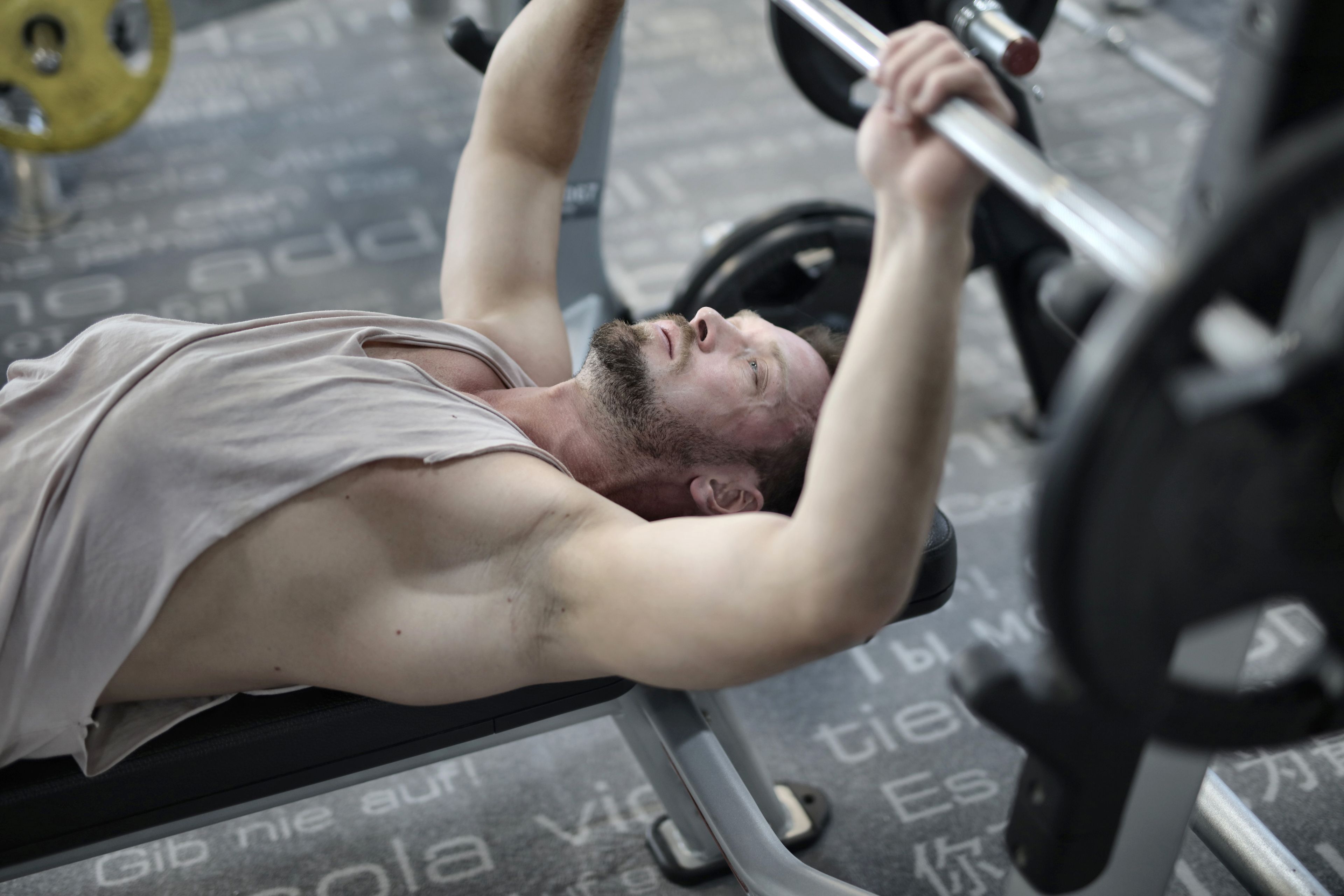
What does a scaled Arnold split look like?
Keep the rotation, cut each session to about 14 hard sets, and use two or three sets per exercise instead of five. That gives chest, back, and hamstrings about 12 direct sets a week, quads 10, and arms roughly 12–15 once indirect work counts. Direct sets target a muscle; indirect sets come from exercises where it assists, counted as half in the volume estimate (Pelland et al., 2026).
The scaled version uses 12 weekly direct sets each for chest and back, 10 for quads, 12 for hamstrings, and six for calves. It also has six direct sets each for front delts, side delts, biceps, and triceps, plus four for rear delts. With pulling and pressing counted as indirect work, arms reach about 12–15 weekly sets.
- Add one set per exercise for a lagging muscle only while performance rises, then hold for 3–4 weeks.
- Keep 1–3 reps in reserve on most sets; failure is not required for growth (Grgic et al., 2022).
- Rest 2–3 minutes on compound lifts; three-minute rests produced greater strength and quad thickness than one-minute rests in trained men (Schoenfeld et al., 2016).
- Use how many sets per muscle per week to adjust workload when recovery or progress changes.
Why does the Arnold split stall?
Mostly from recovery debt: six sessions a week at classic volume can outrun sleep, food, and life stress. The rotation also trains front delts and triceps two days in a row, so pressing strength often stalls first; missed days can break the cycle.
- Watch for reps dropping across the week, aching joints, or sessions you keep skipping. These are signs you’re under-recovered, not overtrained.
- Chest-and-back day includes pressing; the next day adds overhead pressing and triceps work. StrengthLog notes that front delts and triceps “get hammered pretty hard two days in a row” (StrengthLog).
- One missed session shifts the six-day sequence; missing two can leave a muscle trained only once that week.
- If your weights have been flat for 3–4 weeks, cut volume by a third before changing splits. More weekly sets can help, but their returns diminish (Schoenfeld, Ogborn & Krieger, 2017).
Flat weights, aching joints, and skipped sessions can come from volume, sleep, food, or stress. See whether recovery is your bottleneck to identify what to adjust first.

Is the Arnold split better than PPL?
Not inherently. Both train each muscle twice a week over six days, and when weekly sets are matched, split type makes little difference. The Arnold split pairs opposing muscles; push pull legs routine groups muscles by movement and spreads shoulder and triceps work more evenly.
- A 2016 meta-analysis found twice-weekly training outperformed once-weekly training, mainly through extra volume (Schoenfeld, Ogborn & Krieger, 2016).
- When volume is equated, research finds no significant frequency difference (Schoenfeld, Grgic & Krieger, 2019).
- Choose Arnold if you like chest-and-back pairings and arm days; choose PPL if pressing keeps stalling. Volume-equated split and full-body routines also showed no significant difference in a 2024 review (Ramos-Campo et al., 2024).
- Training four days? Run the rotation continuously, so each muscle gets trained two to three times every two weeks, or switch to upper/lower.
The best split is the one that fits your recovery and schedule. If you want help sorting out what is holding your progress back, take the quick, one-tap diagnosis.
FAQ
What was Arnold's actual split?
In The New Encyclopedia of Modern Bodybuilding, the split is a six-day rotation: chest and back, shoulders and arms, then legs, repeated, with Sunday off (StrengthLog). Each muscle is trained twice a week. Online versions vary, but this is the layout attributed to the book.
Is the Arnold split better than PPL?
Not inherently. Both train each muscle twice a week over six days, and matched weekly volume makes little difference to growth (Ramos-Campo et al., 2024). Pick Arnold for chest-and-back pairing and arm days; pick PPL if your pressing keeps stalling.
What is the 4-day Arnold split?
There is no single official version. Keep the three-day rotation and run it continuously across four training days a week, so each muscle is trained two to three times every two weeks. Keep sessions near 14 hard sets to manage workload.
What is a good 6-day split?
Choose one that trains each muscle twice weekly and lets you recover. The Arnold split scaled to about 14 hard sets per session and six-day push pull legs both fit. If six days regularly becomes four or five, use a four-day upper/lower split instead.
Written and maintained by LiftDecode. Training and nutrition education for healthy adults, not medical advice — if you have a health condition or an injury, talk to a professional who can examine you.