Push Pull Legs Routine: 3- and 6-Day Versions
A complete push pull legs routine for 3 or 6 days a week, with sets and reps, the weekly sets each muscle actually gets, and why most PPL stalls aren't the split's fault.
- Published
- Reading time
- 7 min
- By
- LiftDecode

A push pull legs routine groups training into three days: push (chest, shoulders, triceps), pull (back, biceps, rear delts), and legs. Train three days a week to work each muscle once, or six days to work each twice. Progress depends on weekly sets, recovery, and a rule for adding weight.
What is a push pull legs split?
Push pull legs (PPL) groups muscles by movement: push day trains chest, shoulders, and triceps; pull day trains back, biceps, and rear delts; leg day trains quads, hamstrings, glutes, and calves.
Train three days a week to work each muscle once, or six days to work each twice. You can schedule six days as Push-Pull-Legs-Rest-Push-Pull-Legs, or train six days in a row if your schedule and recovery allow.
PPL leaves room for several exercises per muscle group. The ACSM position stand recommends 2–3 training days weekly for novices, 3–4 for intermediate lifters, and 4–5 for advanced lifters. Compare all workout splits and where each one stalls or bro split vs PPL.
| Version | Training days | Frequency per muscle | Session length |
|---|---|---|---|
| 3-day PPL | 3 | Once a week | Longer |
| 6-day PPL | 6 | Twice a week | Shorter |
What does a 6-day push pull legs routine look like?
Use two versions of each day: A days emphasize heavier compounds and lower reps; B days use moderate reps. Each session has 13–19 working sets. Rest 2–3 minutes between compound sets and 1–2 minutes between isolation sets.
Both lighter and heavier loads can build muscle when sets are hard; heavier loads build more one-rep max strength (Schoenfeld et al., 2017). In trained men, three-minute rests also produced more strength and quad growth than one-minute rests over eight weeks (Schoenfeld et al., 2016).
| Day | Exercise | Sets × reps |
|---|---|---|
| Push A | Bench press | 4 × 5–8 |
| Overhead press | 3 × 6–10 | |
| Incline dumbbell press | 3 × 8–12 | |
| Lateral raise | 3 × 12–20 | |
| Triceps pushdown | 3 × 10–15 | |
| Pull A | Barbell or chest-supported row | 4 × 6–10 |
| Pull-up or lat pulldown | 3 × 6–12 | |
| Face pull | 3 × 12–20 | |
| Barbell curl | 3 × 8–12 | |
| Legs A | Back squat | 4 × 5–8 |
| Romanian deadlift | 3 × 6–10 | |
| Leg press | 3 × 10–15 | |
| Lying leg curl | 3 × 10–15 | |
| Standing calf raise | 4 × 8–15 | |
| Push B | Incline barbell press | 4 × 6–10 |
| Machine or dumbbell chest press | 3 × 8–12 | |
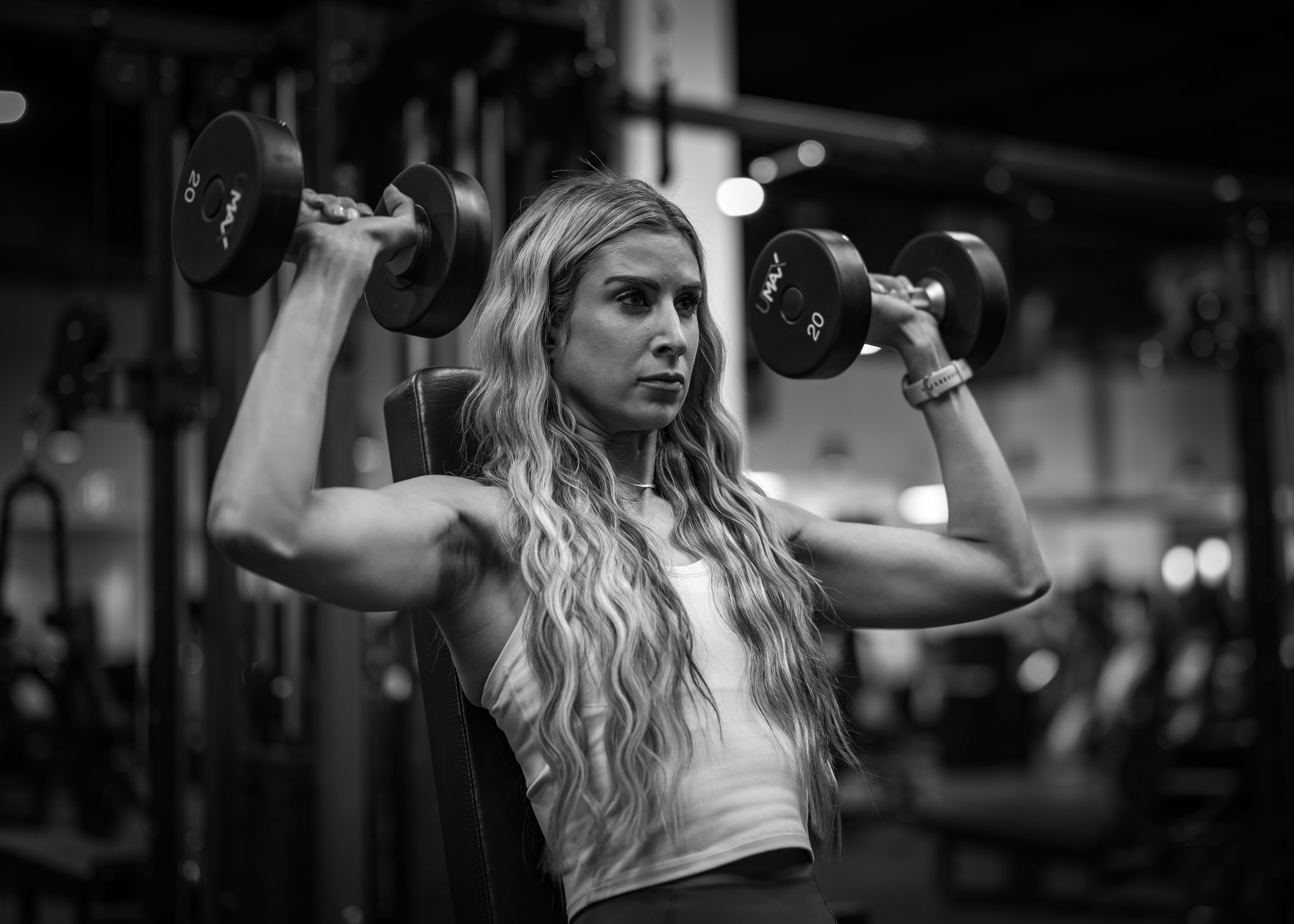
| Seated dumbbell shoulder press | 3 × 8–12 | |
| Cable lateral raise | 3 × 12–20 | |
| Overhead triceps extension | 3 × 10–15 | |
| Pull B | Lat pulldown | 4 × 8–12 |
| Seated cable row | 3 × 8–12 | |
| Rear-delt fly | 3 × 12–20 | |
| Incline dumbbell curl | 3 × 10–15 | |
| Hammer curl | 2 × 10–15 | |
| Legs B | Hack squat or front squat | 3 × 8–12 |
| Hip thrust | 3 × 8–12 | |
| Bulgarian split squat | 3 × 8–12 per leg | |
| Seated leg curl | 3 × 10–15 | |
| Leg extension | 3 × 12–15 | |
| Seated calf raise | 4 × 10–15 |
- Run A days followed by B days; for a three-day version, use A days only.
- Follow the progression rule below and keep exercises consistent week to week.
How many sets does each muscle get from PPL?
The six-day template gives chest, back, and quads about 14–16 direct sets weekly; most smaller muscles get 6–9 direct sets plus indirect work. The three-day version roughly halves that dose: 6–7 direct sets for major muscles, once a week.
A direct set targets a muscle as a primary mover; an indirect set works it as a secondary mover. Count an indirect set as half a set for comparison—for example, a bench set counts fully for chest and half for triceps. This method appears in Pelland et al., 2026, a review of 67 studies and 2,058 participants. Muscle size and strength rose with weekly volume, with diminishing returns. See how many sets per muscle group per week.
| Muscle | 6-day PPL: direct (with indirect) | 3-day PPL: direct (with indirect) |
|---|---|---|
| Chest | 14 | 7 |
| Back (lats and mid-back) | 14 | 7 |
| Quads | 16 | 7 |
| Hamstrings | 9 | 6 |
| Glutes | 3 (≈11) | 0 (≈5) |
| Front delts | 6 (≈13) | 3 (≈6.5) |
| Side delts | 6 (≈9) | 3 (≈4.5) |
| Rear delts | 6 (≈9.5) | 3 (≈5) |
| Triceps | 6 (≈16) | 3 (≈8) |
| Biceps | 8 (≈15) | 3 (≈6.5) |
| Calves | 8 | 4 |
Is a 3-day push pull legs routine enough?
Yes for beginners or busy lifters maintaining progress. For a trained lifter trying to grow, once-weekly training at 6–7 sets is usually a small dose. A 2016 meta-analysis found higher frequency favored growth, largely because it added volume (Schoenfeld, Ogborn, and Krieger, 2016).
Spreading weekly volume across more sessions can keep sets productive. A review of 25 studies found no significant frequency difference when weekly volume was equated (Schoenfeld, Grgic, and Krieger, 2019). If three-day PPL doesn’t fit your needs, consider the 4-day upper lower split or three full-body days.
- Three-day PPL works if you’re newer, maintaining, or progressing on the weekly dose.
- It doesn’t if you’re trained, trying to grow, and stalled on low weekly volume.
How do you progress a push pull legs routine?
Use double progression: choose a rep range, and when every set reaches its top with good form, add the smallest weight jump and restart at the bottom. Keep exercises consistent for 6–8 weeks so progress is measurable.
For example, incline dumbbell press at 60 lb (27 kg) for 3×8–12 might progress from 12, 12, 11 to 12, 12, 12, then 65 lb (29.5 kg) for 9, 8, 8. ACSM recommends increasing load 2–10% once you can do 1–2 reps more than the target (ACSM position stand, 2009). Keep 1–3 reps in reserve on most sets; failure isn’t required (Grgic et al., 2022). See double progression, step by step.
Why does push pull legs stop working?
PPL stalls when progression is unclear, three-day volume is too low, six-day training exceeds recovery, sessions are missed, or eating at maintenance limits growth. Changing exercise order or splits won’t fix those issues.
- Same weights as eight weeks ago? You may lack a progression rule.
- Under about 10 weekly sets for the lagging muscle? You may need more volume.
- Six sessions but under seven hours of sleep, or leg day skipped? Recovery may be the issue.
- Fewer than five of six sessions completed most weeks? The schedule may not fit.
- Bodyweight flat for months while bulking? Your intake may not support growth.
Frequency has little effect on growth when volume is accounted for, while volume has diminishing returns (Pelland et al., 2026). Fix the first “yes.” See which of these is your first bottleneck; more than one “yes” is common, and fix order matters.
What order should push, pull and leg days go in?
Push-pull-legs is the default; push-legs-pull (PLP) puts legs between upper-body days to give shoulders and elbows a day off. Choose an order that separates hard sessions and fits your schedule.
Push and pull share smaller muscles, while heavy hinges followed by squats can tax your lower back. Try:
- Push-Pull-Legs-Rest-Push-Pull-Legs-Rest
- Push-Legs-Pull-Rest-Push-Legs-Pull-Rest
- Push-Pull-Rest-Legs-Rest-Push-Pull-Rest-Legs
FAQ
Is push pull legs actually effective?
Yes, if each muscle gets enough weekly sets and the plan supports progression. Six days in this template gives major muscles 14–16 direct sets and twice-weekly training; three days provides about half that dose.
What order should you do push, pull and leg days?
Push-pull-legs works well as the default, while push-legs-pull gives shoulders and elbows another day off. If pull day includes heavy hinges, avoid heavy squats the next day or put a rest day after legs.
Is it better to do PPL or PLP?
Neither is better in general; weekly sets and progression matter more than order. Choose PLP if your shoulders or elbows feel beaten up, and PPL if you want the push day between heavy pulling and squatting.
Should I do push pull legs 3 or 6 days a week?
Choose six days if you can recover and rarely miss sessions; you’ll train each muscle twice weekly and get roughly double the weekly sets. Choose three if your schedule or sleep can’t support six; a four-day upper/lower split can also train each muscle twice weekly.
Written and maintained by LiftDecode. Training and nutrition education for healthy adults, not medical advice — if you have a health condition or an injury, talk to a professional who can examine you.