How Many Sets per Muscle Group per Week?
How many sets per muscle group per week: 10–20 hard sets for most lifters, as few as 4 still works. What meta-analyses show and how to count sets.
- Published
- Reading time
- 7 min
- By
- LiftDecode
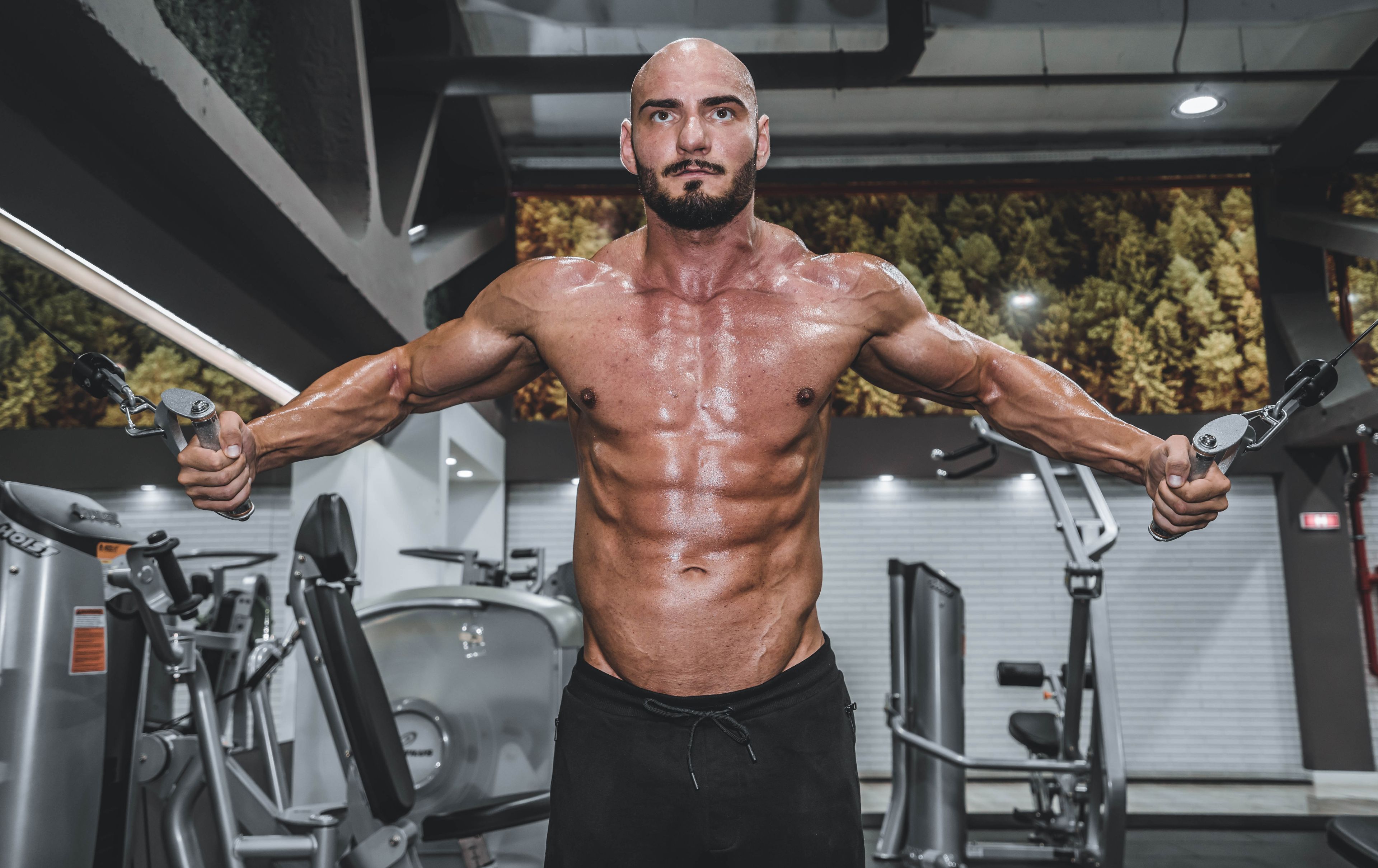
Most lifters build muscle best with about 10–20 hard sets per muscle group per week. A landmark meta-analysis found at least 10 weekly sets were needed to maximize growth, and a review of trained men put the sweet spot at 12–20. As few as 4 hard sets a week still builds muscle, and returns shrink as you go higher. Use this range alongside a clear sets, reps, rest and progression hub when you plan your training.
How many sets per muscle group per week build the most muscle?
Around 10–20 hard sets per muscle per week is a strong starting target. A 2017 meta-analysis found average growth rose across three volume groups:
- Under 5 sets: 5.4% growth
- 5–9 sets: 6.6% growth
- 10 or more sets: 9.8% growth
The analysis covered 15 studies and 34 treatment groups; each additional weekly set was associated with about 0.37% more growth (Schoenfeld, Ogborn & Krieger, 2017). A review focused on trained men recommended 12–20 weekly sets as a standard target. It found no clear advantage of more than 20 over 12–20 sets for quads or biceps, though higher volume favored triceps (Baz-Valle et al., 2022).
A 2026 Sports Medicine meta-regression of 67 studies and 2,058 participants found that muscle growth continued to rise with volume, but gains diminished as sets accumulated (Pelland et al.). The practical lesson is to start near the low end and earn any increase through progress and recovery.
What counts as a "set"?
A set counts when it is a working set that ends close to failure; use roughly 1–3 reps in reserve as LiftDecode’s practical rule. Reps in reserve, or RIR, means how many more good reps you think you could have completed. Growth tends to improve as sets end closer to failure, but training to the point where you cannot complete another rep is not required (Robinson et al., 2024; Refalo et al., 2023).
- Counts: Working sets finished about 1–3 reps short of failure.
- Doesn’t count: Warm-up sets.
- Doesn’t count: Sets stopped with 5 or more reps left.
Use the reps in reserve (RIR) guide to make your effort estimates more consistent. If you need help choosing movements, see how many reps to build muscle.

How do you count compound exercises?
Count a compound lift as one full set for its main target muscle and half a set for each helper. The recent meta-regression found that this fractional method fit the evidence better than counting indirect work as either a full set or nothing (Pelland et al.).
For example:
- Pull-ups or rows: back 1, biceps 0.5.
- Squats: quads 1, glutes 0.5.
- Overhead press: front delts 1, triceps 0.5.
These are practical applications of the fractional method. For exercise selection and planning, see how many exercises per muscle group.
How many sets should beginners do?
For your first year, roughly 6–10 hard sets per muscle per week is LiftDecode’s recommendation. Even 4 weekly sets can produce real growth, and beginners often benefit more from learning to push working sets hard than from adding volume (Schoenfeld, Ogborn & Krieger, 2017).
A review suggested a minimum of 4 weekly sets per muscle using loads that allow 6–15 reps (Iversen et al., 2021). The 6–10 recommendation sits between that minimum and the 10-set threshold associated with maximizing growth. Begin there, track your lifts, and increase only if training is recoverable and progress calls for it.

Is more than 20 sets per week better?
Sometimes, briefly, for a lagging muscle, but 20-plus sets is not a default target. In one 8-week study of trained men, 30–45 weekly sets favored muscle growth at several measured sites over 18–27 sets, while strength gains were similar; the authors cautioned that these results apply specifically to young trained men (Schoenfeld et al., 2019). A separate review found no difference between 12–20 and more than 20 sets for quads and biceps (Baz-Valle et al., 2022).
If one muscle is lagging, LiftDecode’s recommendation is to try 20 or more sets for that muscle in a 4–6-week specialization block, while keeping other muscles at maintenance volume. Then return to a normal range. Watch for signs that you have overshot:
- Reps falling week to week.
- Soreness that lingers.
- Sleep getting worse.
If these show up, review signs you’re overtrained or just under-recovered and reduce the workload if needed.
Do you need as many sets for strength?
No. Strength shows sharper diminishing returns from added volume than muscle size does, and practicing the lift more often can matter more than piling on sets. In the 2019 study, strength gains were similar across groups doing 1, 3 or 5 sets per exercise (Schoenfeld et al., 2019).
A 2026 meta-regression found that frequency increased strength with diminishing returns, while its effect on hypertrophy was negligible when weekly volume was considered (Pelland et al.). For a strength-focused plan, prioritize frequent, heavy practice on the main lift. See how to get stronger after year one.
Should you add sets when you stall?
Add sets only after checking effort and recovery. If you already do 10 or more genuinely hard sets per muscle, the issue may be sets ending too early, no progression rule, or poor sleep and food—not too little volume.
- Count working sets honestly using the hard-set rule and fractional counting.
- Under 10 hard sets and recovering well? Add 2 sets per week to the lagging muscle.
- At 10–20 sets? Check effort, progression, calories and sleep before adding.
- If performance drops across weeks, cut volume or run a deload week.
Adding 1–2 sets at a time is LiftDecode’s practical recommendation, not a research-derived threshold. Change one thing, then judge the result by performance and recovery.
| Situation | Weekly hard sets per muscle | Notes | Source |
|---|---|---|---|
| Minimum that still builds muscle | 4 | Real growth, just not maximal | Schoenfeld 2017; Iversen 2021 |
| Beginner (first year) | ~6–10 | LiftDecode recommendation between the minimum and 10-set threshold | Schoenfeld 2017 |
| Most lifters building muscle | 10–20 | At least 10 to maximize growth; 12–20 standard for trained men | Schoenfeld 2017; Baz-Valle 2022 |
| Lagging muscle, short specialization block | 20+ for 4–6 weeks | Higher volume helped trained men, with diminishing returns | Schoenfeld 2019; Pelland 2026 |
| Strength-focused lifter | Fewer sets, more frequent main-lift practice | Strength has sharper diminishing returns; frequency helps | Pelland 2026; Schoenfeld 2019 |
| Counting a compound lift | 1 set for target, 0.5 for helpers | Fractional counting fit the data best | Pelland 2026 |
A hard set is a working set that ends roughly 1–3 reps short of failure.
If your volume is already in range and you’re still flat, the cause is usually elsewhere. Find out whether volume is really your bottleneck and check training, food, sleep and recovery before adding more sets.
FAQ
Is 15 sets for chest too much?
No. Fifteen hard sets a week sits in the middle of the 10–20 range supported by the evidence (Baz-Valle et al., 2022). It may be too much if your bench and fly numbers fall week to week or your shoulders ache. Dips also add indirect chest work, counted as half sets.
How many sets to build muscle per workout?
Divide your weekly target by how often you train the muscle. Fifteen weekly sets over two sessions is 7–8 per session, spread across two or three exercises. Frequency itself has little effect on muscle growth when weekly volume is the same, so choose a split that lets you keep each set hard.
Is 3 sets per exercise enough?
Yes; the weekly total per muscle matters more than the number per exercise. Three hard sets of two exercises, twice a week, gives 12 weekly sets, within the 10–20 range. Three sets of one exercise once a week gives 3, which can build some muscle but is below the range associated with maximizing growth.
Do warm-up sets count toward weekly volume?
No. Only working sets taken close to failure count. Growth tends to improve as sets end closer to failure (Robinson et al., 2024), so light warm-ups and sets stopped with five or more reps left are not hard sets.
Written and maintained by LiftDecode. Training and nutrition education for healthy adults, not medical advice — if you have a health condition or an injury, talk to a professional who can examine you.