Hip Thrust Form: Feel It in Your Glutes, Not Your Back
Hip thrust form that hits your glutes: bench, bar and foot position, the rep step by step, and 4 mistakes that move the work to your back, quads or hamstrings.
- Published
- Reading time
- 7 min
- By
- LiftDecode
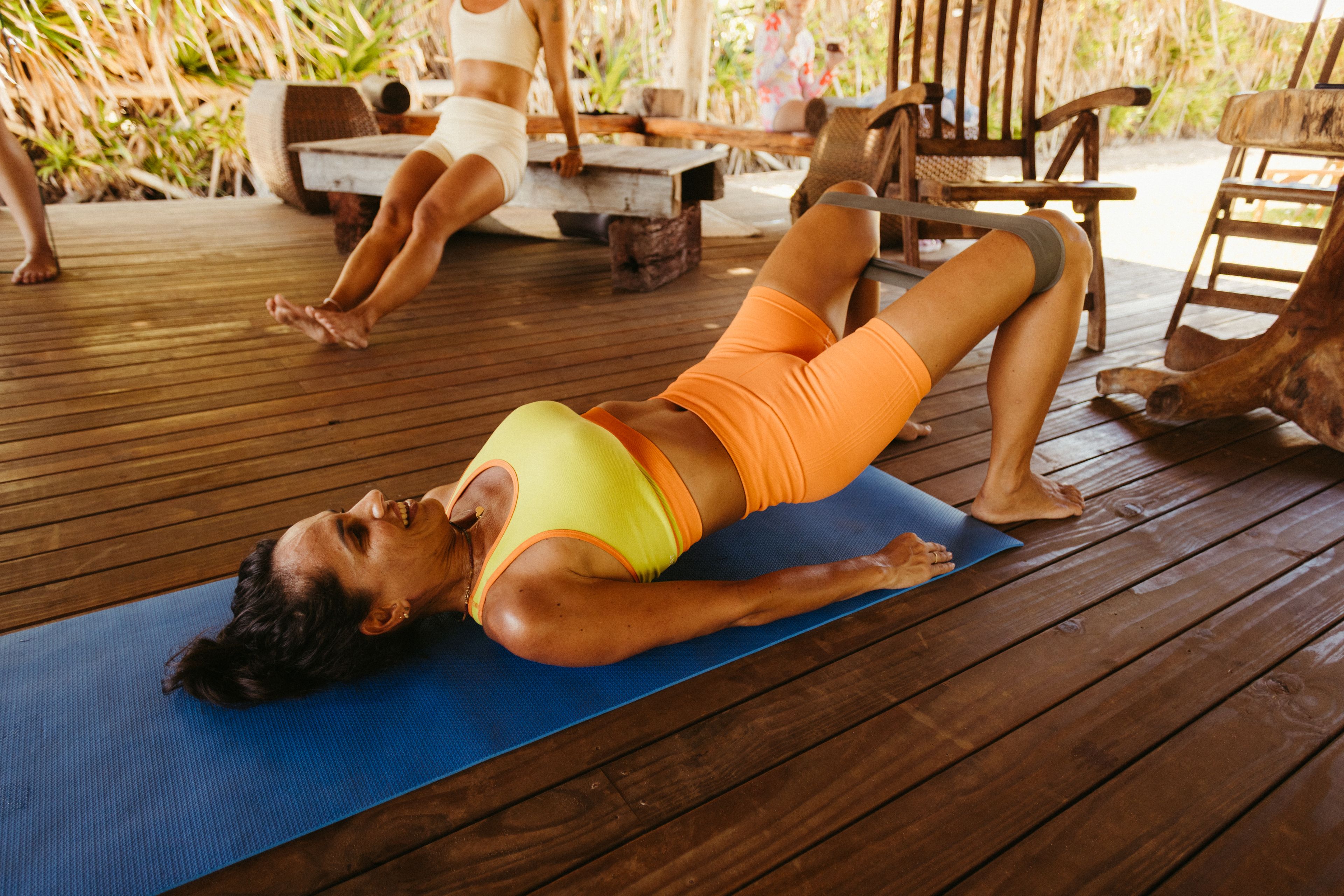
Good hip thrust form means your upper back rests on a bench at the bottom of your shoulder blades, your feet are placed so your shins are vertical at the top, and you drive through your heels until your hips are level with your torso. Finish with ribs down and chin tucked instead of arching your lower back, and lower all the way each rep.
How do you set up for a hip thrust?
Sit with the bench edge just below your shoulder blades, roll a padded bar into your hip crease, and plant your feet about shoulder-width apart so your shins will be vertical at the top. Tuck your chin, brace, and push through your heels.
- Set a roughly knee-height bench with its edge under the bottom of your shoulder blades.
- Place a padded bar in your hip crease and hold it steady with your hands.
- Keep feet shoulder-width, toes slightly out and heels down; adjust until shins are vertical at the top.
- Keep your chin tucked, ribs down and eyes forward, not aimed at the ceiling.
Setup is where most form problems start; our exercise form guides break down the other main lifts the same way.
How do you do a hip thrust, step by step?
Drive through your heels until your thighs and torso form a straight line, squeeze your glutes with ribs down, then lower until your hips drop well below the bench. Your upper back pivots on the bench; your lower back never arches.
- Brace and push through your mid-foot toward your heels.
- Rise until your hips are level with your torso; tuck your pelvis slightly at the top.
- Pause for 1 second without arching your lower back.
- Lower under control to a deep bottom, then repeat without bouncing off the floor.
The bottom matters because the hardest part of the rep comes early. In a biomechanics study of 19 trained men, peak hip-extension demand occurred about 14% into the lift, with hips flexed roughly 83 degrees, then fell by about two-thirds by lockout (Brazil et al., 2021). That makes a deep, controlled rep more useful than spending the whole set on top-half pulses.
Which hip thrust mistakes move the work away from your glutes?
Four faults explain most “I feel it everywhere but my glutes” complaints: an arched finish, feet in the wrong spot, skipping the bottom, and repeating the same pump sets for months. The first three shift the work; the last leaves no reason for your glutes to keep adapting.
- Arching to finish: If your ribs flare, head tips back and lower-back curve deepens, your back is taking the finish. Film from the side; keep ribs over hips and chin tucked, and think “ribs down, tuck your tailbone.”
- Feet too close or far: Check for vertical shins at lockout. Foot position changes thigh-muscle activity; in coaching practice, close feet and pushing through the toes tend to feel quad-heavy, while far feet tend to feel hamstring-heavy. Move your feet and push through your heels. A study of seven experienced trainers found that foot position and force direction changed EMG in every measured muscle except gluteus medius (Collazo García et al., 2020).
- Skipping the bottom: If your hips never drop below bench height, you’re training the easier top portion. Film from the side and make full range your default; add partials only after full reps.
- Pump sets forever: If your log still shows the same weight and 3 × 15 or 8-8-8 routine months later, use double progression. Work in an 8–12 rep range and add load when every set reaches 12.
Do hip thrusts build glutes better than squats?
Hip thrusts build glutes about as well as squats, with less quad and adductor growth. They produce more glute activity on EMG, a measure of electrical muscle activity, but greater activity does not automatically mean greater growth.
At 10RM, hip thrusts produced higher mean upper and lower glute max EMG than back squats in 13 trained women (Contreras et al., 2015). But in a 9-week training study, hip thrusts and squats led to similar glute growth; squats grew quads and adductors more, while deadlift strength transfer was similar (Plotkin et al., 2023).
| Measure | Hip thrust | Back squat | Source |
|---|---|---|---|
| Upper glute max EMG (mean, 10RM) | 69.5% MVIC | 29.4% MVIC | Contreras et al., 2015 |
| Lower glute max EMG (mean, 10RM) | 86.8% MVIC | 45.4% MVIC | Contreras et al., 2015 |
| Glute growth, 9 weeks | Similar | Similar | Plotkin et al., 2023 |
| Quad and adductor growth | Less | More | Plotkin et al., 2023 |
| Deadlift strength transfer | Similar | Similar | Plotkin et al., 2023 |
A 2025 meta-analysis of 11 studies found an overall training effect on glute max size and concluded that barbell hip thrusts increase glute max hypertrophy (Krause Neto et al., 2025). Hip thrusts also place relatively low force and stretch demands on the hamstrings, lower than walking in one analysis (Breed et al., 2026). Pair thrusts with deep squats, since squat depth matters for glute growth (see squat form), and a hamstring-dominant hinge such as the Romanian deadlift (see RDL form).
How should you program hip thrusts?
Do hip thrusts once or twice a week for 3–4 hard sets of 6–12 reps, either as your main glute lift or after squats or deadlifts. Add reps, then weight; count those sets toward 10 or more weekly glute sets, and keep partials and holds as finishers.
- Use double progression: add reps within the range, then increase weight when all sets reach the top.
- Treat 8-8-8 as a social-media finisher: 8 full reps, 8 partials and an 8-second hold. Only the full reps load the bottom, where the lift is hardest.
- Try a single-leg hip thrust as a variation, while keeping the same controlled range and stacked torso.
- Build your weekly plan around recoverable hard sets; the ACSM 2026 position stand recommends at least 10 weekly sets per muscle for hypertrophy and says training to failure is not necessary. For more context, see how to build muscle as a woman.
Are your glutes stalled by form or something else?
It’s probably form if you feel hip thrusts mostly in your back, quads or hamstrings, or your range shrinks as the weight climbs. If reps are clean and the weight rises but your glutes don’t change, check weekly volume, effort and food.
Check form first
- Side-view video shows an arched finish, nonvertical shins or a shallow bottom.
- Your reps shorten as you add weight, or you feel the set mainly in other muscles.
Check the plan next
- Your log shows no increase in reps or load over time.
- Your weekly glute work, effort or food intake may not support continued progress.
If your form looks right but your glutes still aren’t changing, find out what’s actually holding your glutes back. The quick diagnosis ranks weekly dose, effort, progression and food so you can address the first likely bottleneck.
FAQ
Why do I not feel hip thrusts in my glutes?
Usually, you finish by arching your lower back, your feet are too close or too far, or you never lower to the bottom. Tuck your chin, keep ribs down, set your shins vertical at the top and use full range; the mind-muscle connection can help you focus, but it does not replace sound setup and progressive training.
What is the 8-8-8 rule for hip thrusts?
It’s a social-media method: 8 full hip thrusts, then 8 partial reps, then an 8-second hold, counted as one set. It can serve as a finisher, but partials near lockout and the hold train the lightest part of the rep, so don’t let it replace progressive full-range sets.
Are hip thrusts actually beneficial?
Yes. In a 9-week trial, hip thrusts grew the glutes about as much as squats, though squats grew quads and adductors more (Plotkin et al., 2023). They’re especially useful if squats are limited by your knees, back or mobility.
How do you know if you're doing hip thrusts correctly?
Film from the side. At the top, your shins should be vertical, hips level with your torso, ribs stacked over hips and chin tucked; at the bottom, your hips should drop well below the bench. You should feel the work mostly in your glutes.
Written and maintained by LiftDecode. Training and nutrition education for healthy adults, not medical advice — if you have a health condition or an injury, talk to a professional who can examine you.