How to Build Muscle as a Woman: What Actually Works
How to build muscle as a woman: women grow at the same relative rate as men. The training dose, loads, protein and timeline that work, plus a 4-day plan.
- Published
- Reading time
- 7 min
- By
- LiftDecode
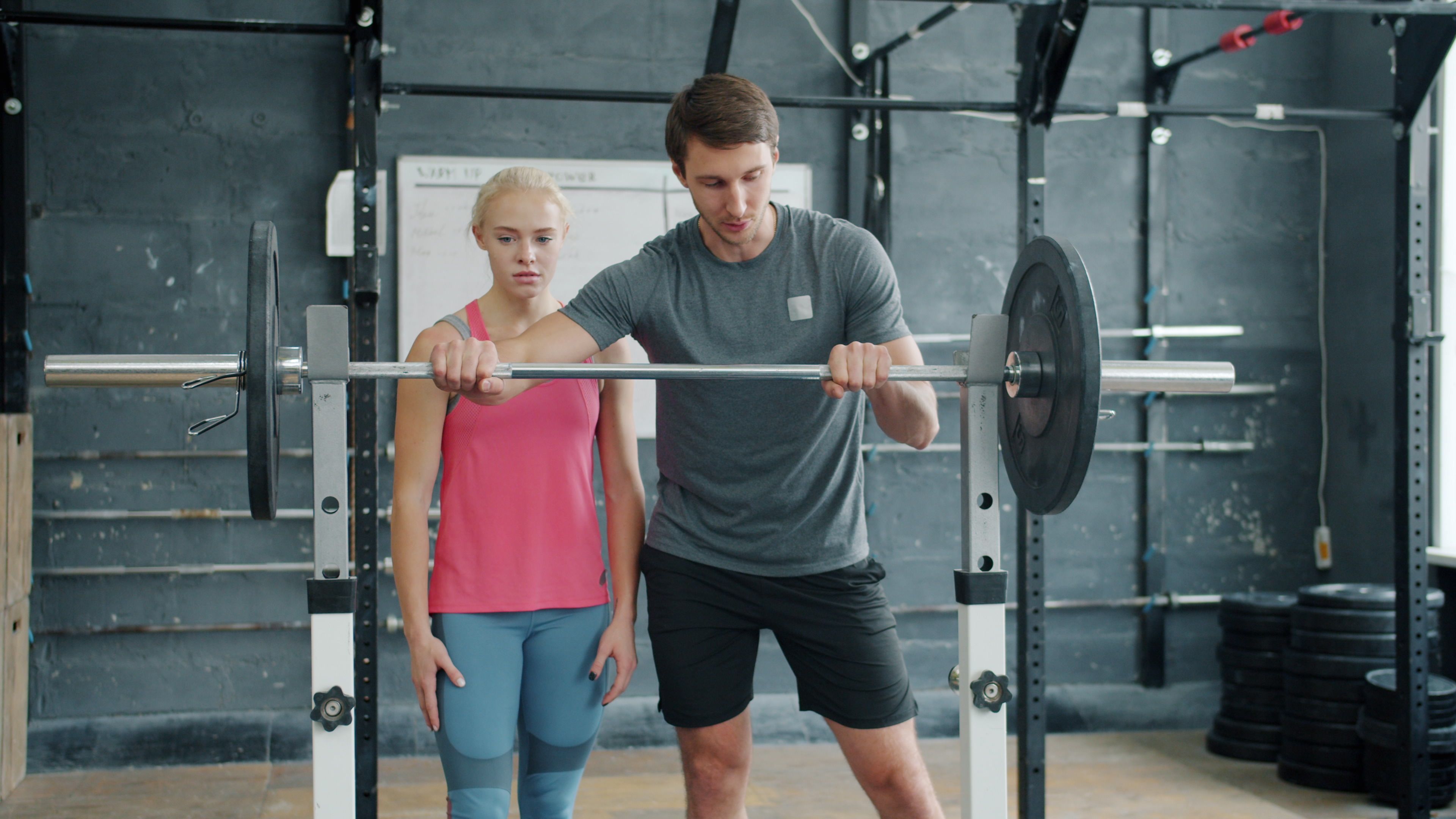
Women build muscle the same way men do: lift progressively heavier weights close to failure, give each muscle about 10 or more hard sets a week, eat around 1.6 g of protein per kg of body weight, and stop dieting while you try to grow. Relative to their starting point, women gain muscle as fast as men.
Is it harder for women to build muscle?
Not in relative terms. A meta-analysis found no significant difference between women and men in percentage muscle growth, and women gained more relative upper-body strength. Women start with less muscle and testosterone, so their absolute gains are smaller, not slower (Roberts, Nuckols & Krieger, 2020).
- Men have more than 15 times women’s circulating testosterone at any age, which helps explain differences in absolute muscle mass, not an inability to grow (Handelsman, Hirschberg & Bermon, 2018).
- In a 12-week study of 585 people, men gained slightly more absolute muscle, while women gained more strength relative to their starting level (Hubal et al., 2005).
- The same basic training levers work for you: hard sets, progressive loads, enough protein and enough food. If progress has stalled, use how to gain muscle when it’s stopped coming easy to check the basics.
Which myths stop women from building muscle?
Four common myths get in the way: light weights “tone,” training must follow your menstrual cycle, heavy lifting makes you bulky by accident, and you can tone one body part. Muscle grows when sets are hard, average cycle effects on performance are trivial, size takes deliberate work, and fat loss happens across the body.
- “Light weights tone; heavy weights bulk.” Muscle growth was similar with light and heavy loads when sets were taken close to failure, but heavier loads produced greater strength gains. Light sets stopped far from failure are unlikely to deliver either result (Schoenfeld et al., 2017).
- “Train by your cycle.” A meta-analysis found only a trivial average performance reduction in the early follicular phase and recommended a personalized approach. Train normally; on days you feel flat, leave an extra rep in reserve (McNulty et al., 2020).
- “I’ll get bulky by accident.” Men have more than 15 times women’s circulating testosterone. Building muscle takes consistent, deliberate training; you won’t wake up accidentally bulky (Handelsman, Hirschberg & Bermon, 2018).
- “I can tone one area.” You can grow a muscle locally, but you can’t make your body burn fat from only that spot. MRI results showed fat loss was generalized, not limited to the trained arm (Kostek et al., 2007).
How should a woman train to build muscle?
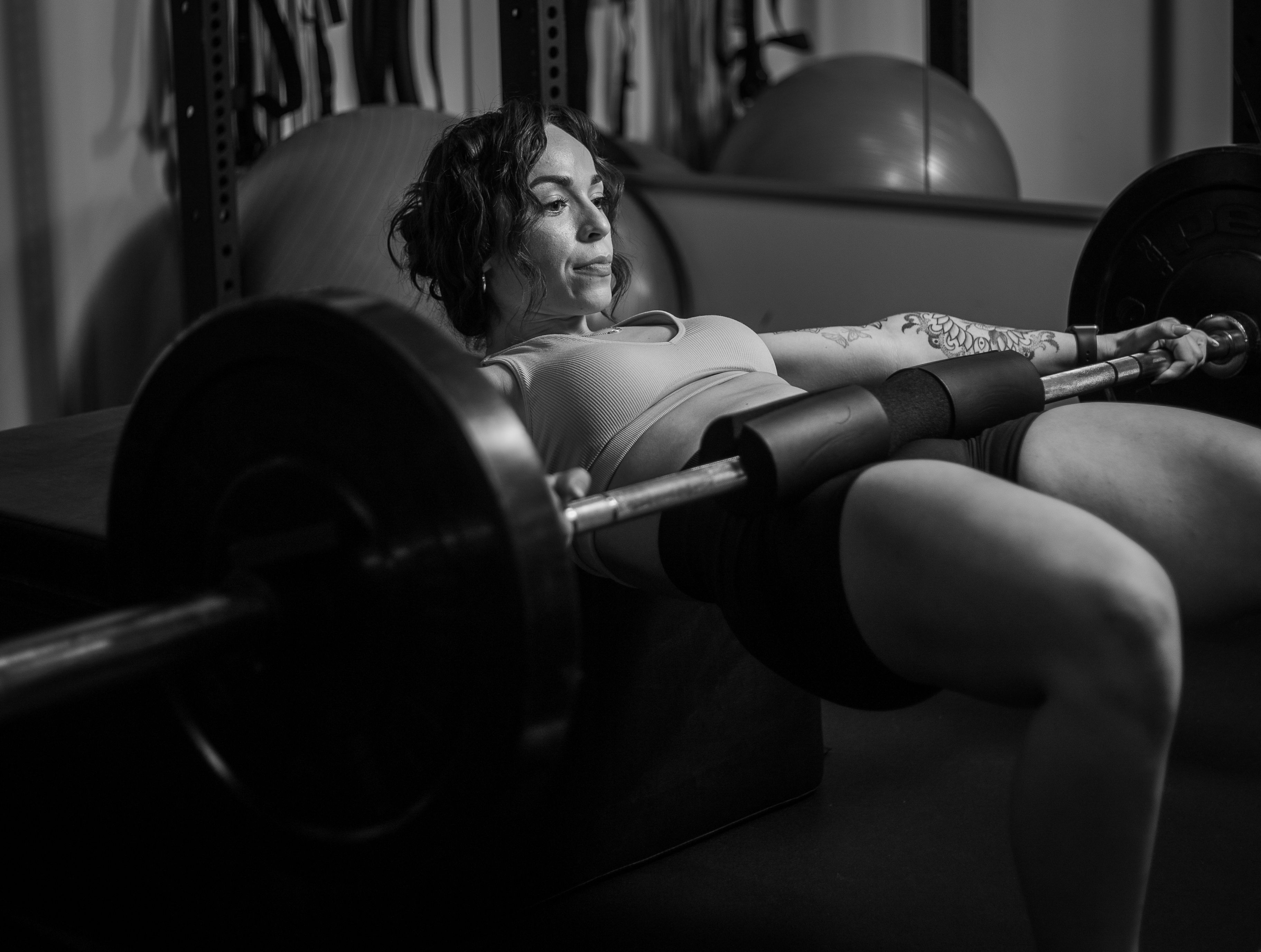
Train each muscle twice a week with about 10–16 hard sets, mostly 6–15 reps, ending sets one or two reps short of failure. Reps in reserve (RIR) means how many more good reps you could have done. Add weight or reps every week or two; a four-day lower/upper split gives your glutes extra work.
| Day | Exercise | Sets × reps | Reps in reserve |
|---|---|---|---|
| Mon – Lower A | Back squat (or goblet squat) | 3 × 6–8 | 1–2 |
| Barbell hip thrust | 3 × 8–10 | 1 | |
| Bulgarian split squat | 2 × 8–10 each leg | 1–2 | |
| Leg extension | 2 × 12–15 | 0–1 | |
| Standing calf raise | 2 × 10–15 | 0–1 | |
| Tue – Upper A | Dumbbell bench press | 3 × 8–10 | 1–2 |
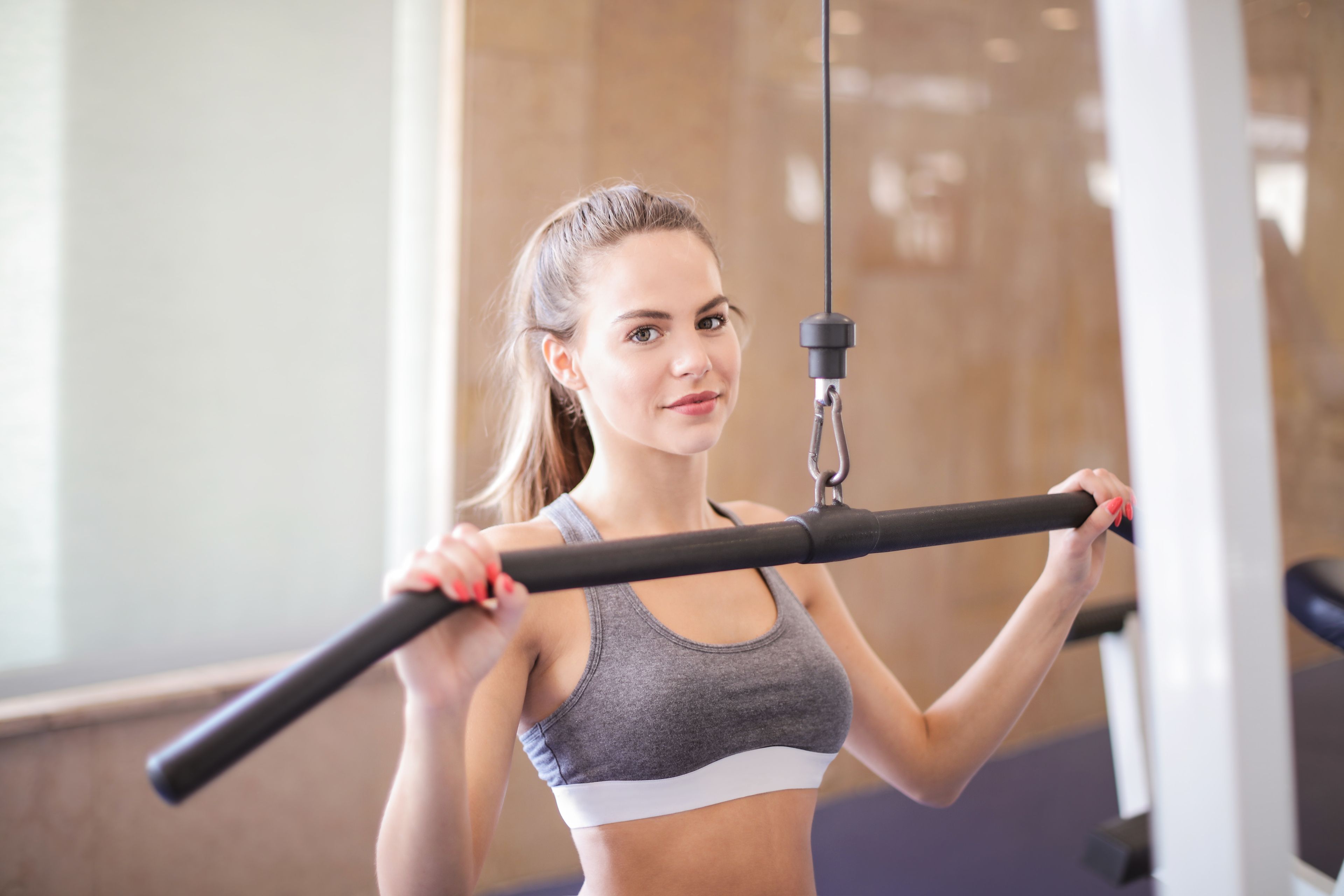
| Lat pulldown | 3 × 8–12 | 1 | |
| Seated dumbbell shoulder press | 2 × 8–12 | 1 | |
| Seated cable row | 2 × 10–12 | 1 | |
| Lateral raise | 3 × 12–20 | 0–1 | |
| Thu – Lower B | Romanian deadlift | 3 × 6–10 | 1–2 |
| Leg press (feet high) | 3 × 10–12 | 1 | |
| Hip abduction machine | 2 × 15–20 | 0–1 | |
| Lying leg curl | 3 × 10–12 | 0–1 | |
| 45° back extension | 2 × 12–15 | 1 | |
| Fri – Upper B | Assisted or bodyweight pull-up | 3 × 6–10 | 1–2 |
| Incline dumbbell press | 3 × 8–12 | 1 | |
| One-arm dumbbell row | 3 × 10–12 | 1 | |
| Cable lateral raise | 2 × 15–20 | 0–1 | |
| Dumbbell curl + triceps pushdown | 2 × 10–15 each | 0–1 |
This LiftDecode template gives glutes roughly 12–16 hard sets a week and trains each major muscle twice. Weekly sets were associated with more growth, with 10 or more per muscle trending toward the largest gains (Schoenfeld et al., 2017); twice-weekly training outperformed once-weekly training in a volume-equated comparison (Schoenfeld et al., 2016). Rest 2–3 minutes after the first exercise and 60–90 seconds after other exercises.
- Use double progression: build reps within the range, then add 5 lb (2.5 kg) to lower-body barbell lifts or the next dumbbell size for upper body.
- Keep most working sets one or two reps from failure; take smaller isolation exercises closer when your form stays controlled.
- Make the barbell hip thrust a glute staple, and review hip thrust form if you’re unsure of your setup. For volume guidance, see how many sets per muscle group per week.
What should a woman eat to gain muscle?
Aim for about 1.6 g of protein per kg of body weight a day (0.7 g per lb), spread over three or four meals of 20–40 g, and eat enough to hold your weight steady or gain slowly. Hard dieting and building muscle rarely mix.
- Protein target: Fat-free-mass gains plateaued around 1.62 g/kg/day across 49 trials, so more isn’t automatically better (Morton et al., 2018).
- Per meal: A 20–40 g serving every 3–4 hours is a practical target (Jäger et al., 2017).
- Calories: Beginners can often build at maintenance. When progress slows, a small surplus supporting weight gain of roughly 0.25–0.5% per week can help (Iraki et al., 2019).
- Example: At 135 lb (61 kg), aim for about 100 g daily, such as four meals with roughly 25 g each. Use the protein intake calculator to find your starting target.
Expect the scale to rise slowly if you’re eating in a surplus. That can be part of building muscle, not a sign you’re doing something wrong.
How long does it take for a woman to build muscle?
Measurable change can start within weeks: in a 12-week study, women’s upper-body muscle thickness had increased by week 6 and was up 10–31% by week 12, while strength improved by week 4 (Abe et al., 2000). LiftDecode’s practical estimate is that visible change usually takes two to three months of consistent training.
- In that study, women’s lower-body muscle thickness rose 7–8%, while chest press strength increased 27% and knee extension strength 19%.
- Upper-body changes appeared sooner in the study; expect glutes and quads to take longer to look different.
- Age can slow gains but doesn’t stop them: adults over 50 gained less lean mass as age increased (Peterson et al., 2011). See strength training for women over 40 and realistic timelines for building muscle.
How do you know it’s working?
Your logbook should show heavier weights or more reps every week or two, measurements should change gradually, and photos taken a month apart may show progress. If your lifts stall for three weeks, check what’s limiting you.
- Track the top sets of your main lifts, monthly glute, thigh, upper-arm and waist measurements, and photos every four weeks in the same light.
- Don’t judge by the scale alone; gaining muscle can raise your weight slightly.
- If you stall for three or more weeks, check effort, weekly sets, protein, calories and sleep.
If you’ve trained for months without visible change, there may be more than one reason: sets that stop too early, weights that never go up, low protein or a permanent diet. LiftDecode can help you find out which one is holding you back first.
FAQ
How long does it take to build muscle in females?
Measurable growth can start within about six weeks of hard training; in one 12-week study, women’s upper-body muscle thickness rose 10–31% (Abe et al., 2000). Visible change usually takes two to three months, while a clearly more muscular physique takes a year or more of consistent progression.
Is it harder for females to grow muscle?
No. Women’s muscles grow at a similar relative rate to men’s (Roberts et al., 2020). Women start with less muscle and much less testosterone, so absolute gains are smaller, but the training that works is the same.
What should a woman eat to gain muscle?
Aim for roughly 1.6 g of protein per kg of body weight daily, spread over three or four meals of 20–40 g, and eat enough to keep your weight steady or rising slowly. Carbohydrates fuel hard sessions, and a long, aggressive diet commonly gets in the way of growth.
What age is hardest to gain muscle?
There’s no age where muscle building stops working, but gains slow with age. In adults over 50, older participants added less lean mass from training (Peterson et al., 2011); starting at 40, 50 or 60 still works.
Written and maintained by LiftDecode. Training and nutrition education for healthy adults, not medical advice — if you have a health condition or an injury, talk to a professional who can examine you.