Bulgarian Split Squat Form: Foot Position and Common Mistakes
Bulgarian split squat form: where to put your front foot, how far to lean, how deep to go, and 4 common mistakes that make balance, not your legs, end the set.
- Published
- Reading time
- 7 min
- By
- LiftDecode
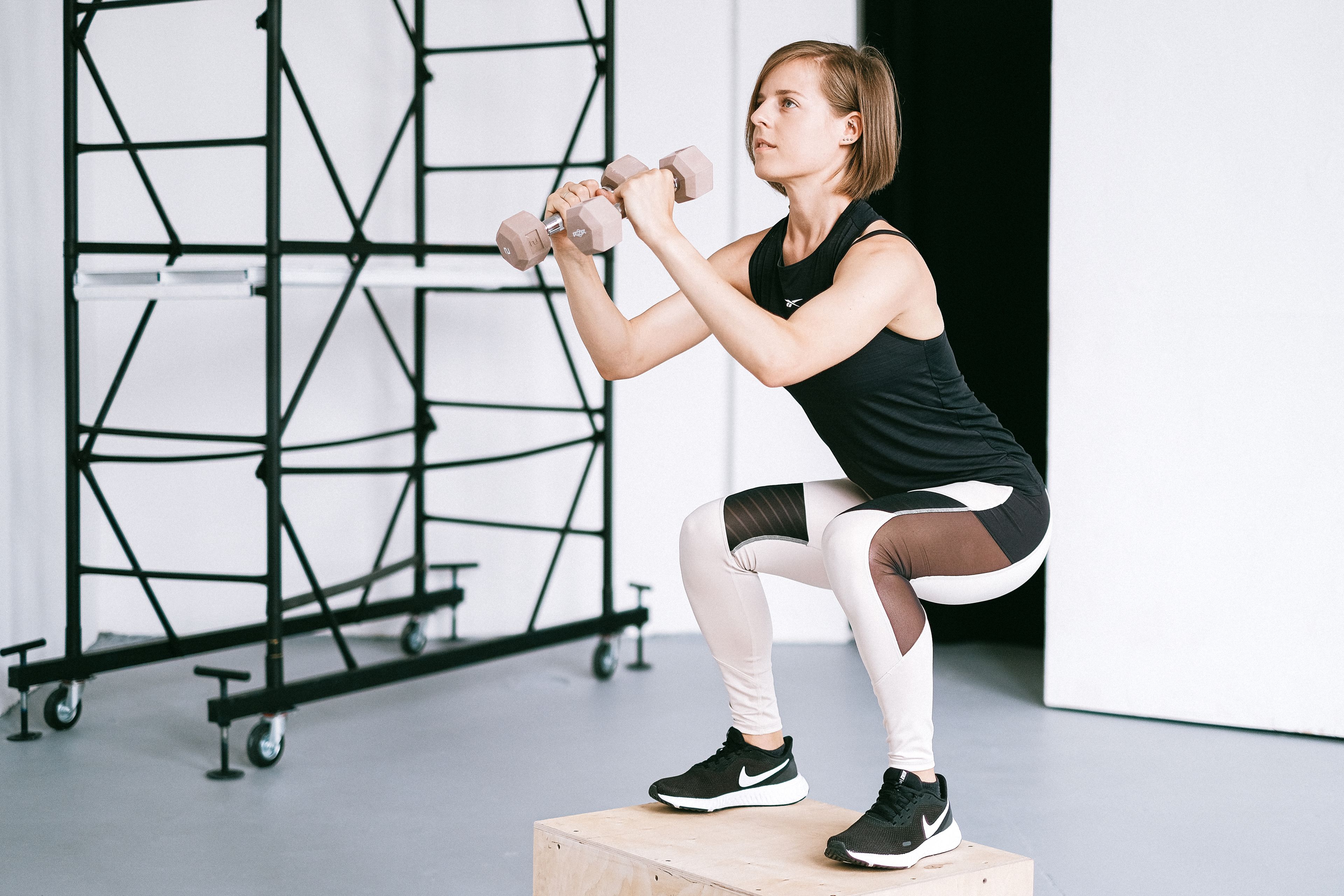
Good Bulgarian split squat form means your rear foot rests laces-down on a knee-height bench, your front foot is far enough forward that your heel stays down at the bottom, and your feet sit hip-width apart, not in a line. You lower straight down until your back knee nearly touches the floor, then drive up through the front foot.
How do you set up a Bulgarian split squat?
Stand a stride in front of a knee-height bench, rest your rear foot on it laces-down, and set your front foot hip-width from the rear foot’s line. Test one rep: your front heel should stay down. Measure that spot and reuse it.
- Set the bench at or just below knee height. A padded roller can support your rear toes.
- Put your feet on “train tracks,” not a tightrope.
- Mark the front-foot distance with a shoe-length measure so you can repeat it.
- Hold dumbbells at your sides, or use a goblet hold while learning. This is one of several exercise form guides.
The lift feels brutal partly because the stance asks you to balance while one leg works hard. Give yourself a wide, stable base before you add load.
How do you do a Bulgarian split squat, step by step?
Brace, then lower straight down, bending the front knee and hip together until the back knee almost touches the floor. Keep your weight on the front foot and push through its mid-foot and heel to stand. Finish one leg before switching.
- Brace and choose an upright torso or a slight lean; keep that angle.
- Lower straight down, letting the front knee track over the toes.
- Stop with the back knee an inch or two above the floor and the front heel down.
- Drive through the front foot; use the rear leg for balance, not a push-off.
If your front knee hurts, shorten the range or adjust your foot position. If pain persists, see a clinician.
Which Bulgarian split squat mistakes cost you progress?
Four mistakes waste sets: a tightrope stance, a front foot that is too close or too far, shallow reps, and a torso that collapses forward. Each can make balance or reduced range end the set before your working leg is truly tired.
- Tightrope stance: If your feet line up, you may wobble or let the knee cave. Film from the front and move the front foot out to hip width. Balance-limited sets underdeliver because the leg gets less useful mechanical tension.
- Front foot too close or too far: From the side, check that your heel stays down at the bottom. Too close can lift the heel; too far can limit depth. Find the distance once and measure it each session.
- Shallow reps: If your back knee stops well above the floor, use a pad or plate as a depth target. In back squats, full-depth training grew glute max and adductors more than half squats; that is squat evidence, not a Bulgarian split squat finding (Kubo et al., 2019).
- Collapsing forward: A chosen lean is fine; an uncontrolled fold is not. Compare your torso angle on the first and last reps, then pick an angle you can hold or reduce the load.
Should you lean forward on Bulgarian split squats?
Lean forward a little if you want more glute work. In trained women, a 40° trunk lean increased glute max and hamstring activity compared with an upright torso, while quad activity did not change. Upright is valid too; keep your spine neutral and hinge from your hips instead of rounding.
In 21 trained female athletes, glute max activity was 21.3% versus 16.3% MVIC, and biceps femoris activity was 21.0% versus 14.5%; vastus lateralis and medialis activity did not change (Aygun-Polat et al., 2025). If you want a direct glute exercise alongside split squats, see our hip thrust form guide.
| Choice | What it changes | Evidence |
|---|---|---|
| 40° forward lean vs. upright | Glute max and biceps femoris activity increased; vastus lateralis and medialis were unchanged | Aygun-Polat et al., 2025 |
| Bulgarian split squat vs. back squat at 10RM | Hip extension moment per leg was 44% higher at the bottom | Arakawa et al., 2023 |
| Hip-width vs. in-line feet | A wider base helps keep balance from ending the set | Coaching practice |
| Front-foot distance | Too close can lift the heel; too far can limit depth | Coaching practice |
What muscles does the Bulgarian split squat work, and how should you program it?
It trains the front leg’s quads and glutes hard, with adductors, hamstrings, and hip stabilizers helping. Per leg, it loads the hip more than a back squat. As a practical starting point, program 2–4 sets of 6–12 reps per leg once or twice a week; those set and rep choices are coaching practice.
You can do it after squats or as your main leg lift, alongside or in place of squat form. Start with the weaker leg, then match its reps on the other side. Add reps before load, and use straps or a barbell or Smith machine if grip limits you.
In eight male rugby players testing both lifts at 10RM, the rear-foot-elevated split squat produced a 44% greater hip extension moment per leg at the bottom and a 47% greater peak moment than the back squat, despite a lighter load (Arakawa et al., 2023).
A six-week study of 24 trained men found that heavy Bulgarian split squat training increased 1RM by 13.0% and vastus lateralis thickness by 9.3% (Wang et al., 2026). Separately, a study of 14 female footballers ranked the loaded, non-elevated split squat among top-tier exercises for glute max force; that is not Bulgarian split squat data (Collings et al., 2023).
Count split squat sets toward your weekly quad and glute work. The ACSM’s 2026 position stand recommends at least 10 weekly sets per muscle for hypertrophy and says training to failure is not necessary (ACSM Position Stand, 2026).
Are your legs stalled by form or something else?
It is likely a form issue if you wobble to a stop, lose depth, or change foot position between sessions. If your front leg is spent at the end of consistent reps and loads rise but your legs do not grow, look at weekly volume, effort, recovery, or food.
- Check form first: Stabilize your stance, repeat your measured foot position, and keep the same depth and torso angle.
- Then check training: Review your weekly work and recovery. For more ways to assess your plan, read how to get bigger legs.
If your split squats are stable, deep, and consistent and your legs still are not growing, form is cleared. Take the quick diagnosis to see which training or recovery factors may be stalling your progress.
FAQ
How do you do a Bulgarian split squat correctly?
Rest your rear foot laces-down on a knee-height bench, keep your feet hip-width apart, and place the front foot far enough forward that its heel stays down. Lower straight down until your back knee nearly touches the floor, then drive up through the front foot.
Should you lean forward on Bulgarian split squats?
Lean slightly if you want more glute work. In trained women, a 40° trunk lean increased glute max and hamstring activity compared with an upright torso (Aygun-Polat et al., 2025). Quad activity did not change, so keep the angle that feels stable and hold it through the set.
What are common mistakes in Bulgarian split squats?
Common mistakes include standing on a tightrope, placing the front foot too close or too far, cutting depth as the set gets hard, and folding forward late in the set. These can turn a leg set into a balance test or make your range inconsistent.
Do Bulgarian split squats grow your glutes?
Very likely. A slight forward lean increases glute activity, and the lift places a greater hip extension moment on each leg than a back squat (Arakawa et al., 2023). Direct glute-growth data are limited: the six-week training study measured the quads, which grew 9.3% (Wang et al., 2026).
Written and maintained by LiftDecode. Training and nutrition education for healthy adults, not medical advice — if you have a health condition or an injury, talk to a professional who can examine you.