Bench Press Calculator: Your Max, Ratio and Plate Milestones
Bench press calculator: estimate your 1RM bench from any set, get your bench-to-bodyweight ratio and training weights, and see how far you are from 225 lb.
- Published
- Reading time
- 7 min
- By
- LiftDecode
Bar included.
Full range, no bounce.
Adds your bench-to-bodyweight ratio.
- 135 lbReached
- 185 lbReached
- 225 lb94% · 13 lb to go
- 315 lb67% · 103 lb to go
135, 225 and 315 are one, two and three 45 lb plates a side on a 45 lb bar; 185 is a plate and a 25.
| Reps | Load (lb) |
|---|---|
| 1 | 210 |
| 2 | 200 |
| 3 | 195 |
| 5 | 180 |
| 8 | 165 |
| 10 | 160 |
| 12 | 150 |
A max-effort set for each rep count, from the Epley formula solved for the load: 1RM ÷ (1 + reps ÷ 30), rounded to 5 lb. These are all-out efforts, not work-set targets.
Sources: One-repetition maximum formulas (Wikipedia); Mayhew et al. 2008, J Strength Cond Res — bench press 1RM prediction accuracy.
Numbers not moving for weeks? Find out why
Enter the weight and reps from your hardest recent bench set, plus your bodyweight, and the calculator estimates your one-rep max, bench-to-bodyweight ratio, and distance to the next plate milestone. Bench is the lift these formulas predict best: in trained and untrained men, they correlate strongly with tested maxes when the set is 10 reps or fewer.
How do you use the bench press calculator?
Enter your heaviest recent set, counting only reps you completed with full range and no help, along with your bodyweight. A set of 3–6 reps that ends close to failure gives a useful estimate; the calculator returns your estimated max, ratio, and distance to the next milestone.
- Enter the total weight on the bar, including the bar.
- Count only reps that touch your chest and finish with elbows locked.
- Leave out bounced reps and any rep where the spotter touches the bar.
- Enter your bodyweight; morning weight is fine because it only affects the ratio.
Choose paused or touch-and-go reps and use that style consistently. For a powerlifting-style pause, the IPF requires the bar to rest motionless on your chest before the press command; its maximum grip width is 81 cm between forefingers (IPF Technical Rulebook 2026). For more tools, see all our lifting calculators.
How does the calculator estimate your bench max?
Your estimate is the average of the Epley and Brzycki equations. In a study of 220 men at different training levels, Brzycki was the most accurate single equation for sets of 10 reps or fewer taken to failure, and the researchers suggested averaging equations to reduce error (Mayhew et al., 1995). A single rep returns the weight you lifted.
- Epley: max = weight × (1 + reps ÷ 30)
- Brzycki: max = weight × 36 ÷ (37 − reps)
At 10 reps, the equations agree; below 10, Epley gives the higher estimate. The calculator accepts 1–12 reps, with a caution above 10. For example, 185 lb (84 kg) for 6 reps gives about 222 lb by Epley and 215 lb by Brzycki, for an estimate of about 218 lb (99 kg).
It also estimates training weights for 1, 2, 3, 5, 8, 10, and 12 reps, using Epley and rounding to the nearest 5 lb (2.5 kg). From a 218 lb estimate, that works out to about 185 lb for 5 reps and 170 lb for 8. See the 1RM calculator, with the full formula breakdown and %1RM chart for the other equations and a full chart.
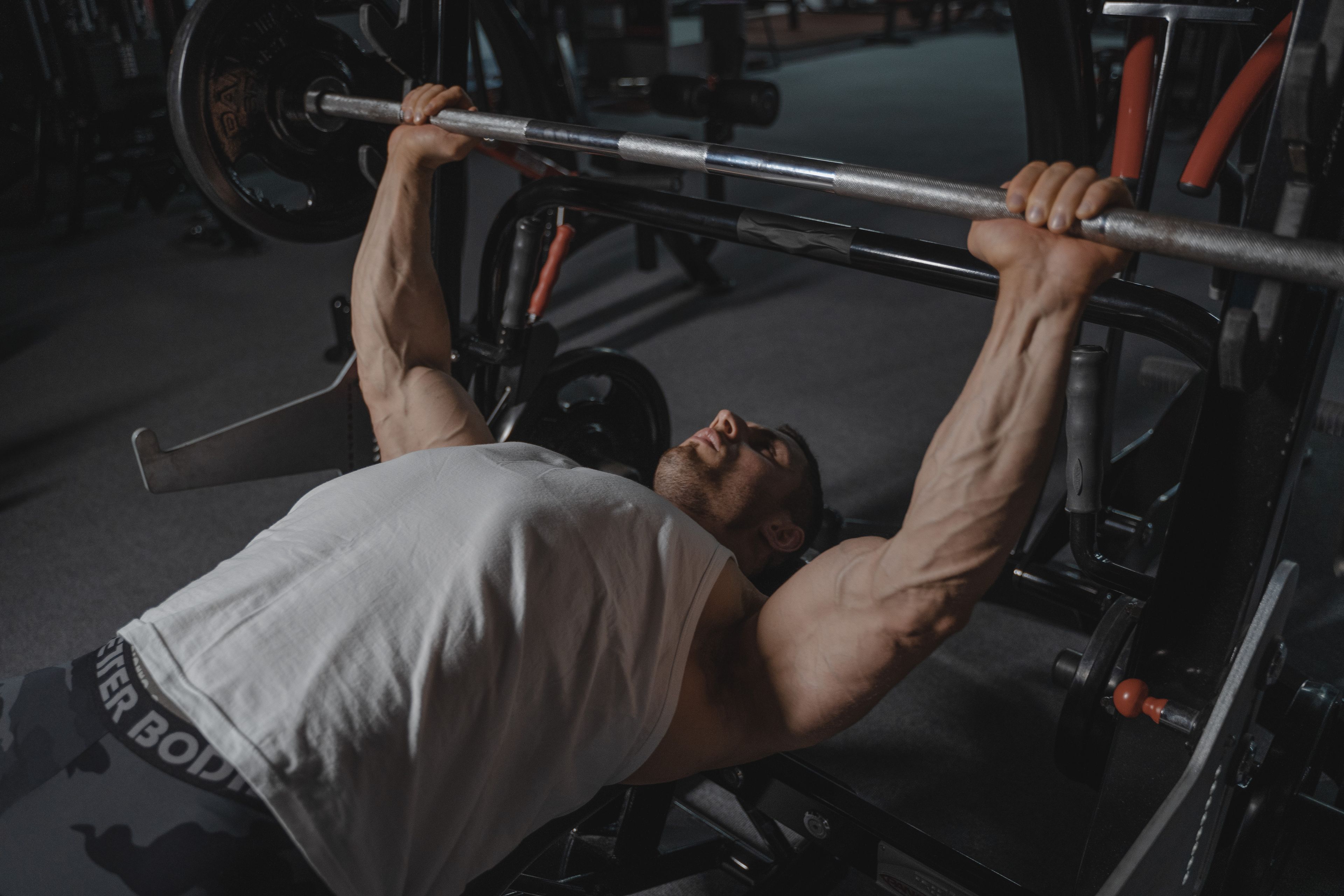
How accurate is a bench press max estimate?
Rep-based estimates tend to work better for bench than for squat or deadlift, but an individual estimate can still miss by a few kilos. Use it to track changes across weeks, not as a promise of the heaviest single you will lift on a meet day.
- In 103 women tested before and after 12 weeks of training, the best equations put 57–67% of estimates within 2.3 kg (5 lb) of actual max; estimates were more accurate below 10 reps (Mayhew et al., 2008).
- In 67 untrained students, bench was predicted most accurately, followed by squat and deadlift; most equations underestimated bench by 2.2–5.4 lb (0.8–6%) (LeSuer et al., 1997).
- A chest-press study found that 5RM predictions explained 99.3% of the variation in tested maxes, compared with 97.6% for 10RM and 95.5% for 20RM (Reynolds et al., 2006).
Keep your reps and technique consistent, and the estimate is useful for following progress. Treat any single reading as an estimate, not your exact max.
What is a good bench press for your bodyweight?
The calculator divides your estimated max by your bodyweight; it does not grade you. Strength Level’s standards put a man at novice at 1.0× bodyweight and intermediate at 1.25×; for women, those levels are 0.5× and 0.75×. A bodyweight bench is a real milestone, not a beginner number.
| Level | Men (× bodyweight) | Women (× bodyweight) | Strength Level definition |
|---|---|---|---|
| Beginner | 0.50 | 0.30 | Stronger than 5% of lifters; practised the lift for at least a month |
| Novice | 1.00 | 0.50 | Stronger than 20%; trained regularly for at least six months |
| Intermediate | 1.25 | 0.75 | Stronger than 50%; trained regularly for at least two years |
| Advanced | 1.50 | 1.10 | Stronger than 80%; progressed for over five years |
| Elite | 2.00 | 1.45 | Stronger than 95%; 5+ years, competitive in strength sports |
These standards use 10.9 million qualifying lifts logged by Strength Level users from 2014–2026, who skew toward trained lifters; “intermediate” describes the middle of people who track lifts, not all adults (Strength Level bench press standards). For example, a 218 lb max at 180 lb bodyweight is 1.21×, just under the men’s intermediate line. See bench press standards by age and weight class for more comparisons.

How many plates is your bench, and how far is the next milestone?
The calculator tracks four milestones in both lb and kg gyms. It shows what share of each milestone you have reached and how much remains.
| Milestone | lb gym (45 lb bar) | Per side | kg gym (20 kg bar) | Per side |
|---|---|---|---|---|
| First plate | 135 lb | 45 lb | 60 kg | 20 kg |
| Plate and a quarter | 185 lb | 45 + 25 lb | 80 kg | 30 kg |
| Two plates | 225 lb | 2 × 45 lb | 100 kg | 40 kg |
| Three plates | 315 lb | 3 × 45 lb | 140 kg | 60 kg |
A men’s Olympic bar weighs 20 kg (44 lb), though US gyms label and count it as 45 lb (Wikipedia: Barbell, Fringe Sport). A 218 lb estimate is 97% of 225, with 7 lb to go; four plates, or 405 lb, is a goal for some lifters but is not a tracked milestone. Read what percentage of men can bench 225 and how rare a 315 lb bench is for context.
Why might your bench estimate be wrong?
Usually the reps were easier than they looked on paper. Bouncing, shortening the range, or getting a spotter’s help inflates the estimate; sets over 10 reps can skew it either way depending on your endurance.
- Bouncing off your chest makes the estimate too high compared with a paused max.
- Not touching your chest or locking out shortens the rep and pushes the estimate up.
- A spotter-assisted last rep does not count; remove it from the set.
- Stopping with several reps in reserve can make the estimate too low.
- Sets of 12 or more are unreliable; formulas were built for 10 reps or fewer (Mayhew et al., 1995).
- A grip or arch change can move the number even when your strength has not changed.
For cues on repeatable setup and range, see bench press setup and the mistakes that cap it.
What should you do when your bench estimate stops going up?
Treat three or four weeks of a flat estimate from honest sets as a stall. Common causes include too little practice, stopping sets far from failure, neglecting your sticking point, or following a program with no rule for adding weight.
- Log one top set per bench session and estimate it the same way each time.
- Check whether you need more weekly practice or sets closer to failure.
- Note whether the bar stalls off your chest or near lockout.
- Look at bar path under heavy loads, sleep, and whether you are cutting calories.
Find the cause before changing everything. The calculator can show that your bench has stalled; why your bench stalled can help you choose what to adjust. If the estimate stays flat, see which cause is actually holding your bench back and use that diagnosis to decide where to focus.
FAQ
How do I calculate my bench press max without maxing out?
Bench a weight for 3–6 clean reps, finishing within a rep or two of failure, then enter the weight and reps. Epley and Brzycki convert that set into an estimated max; on bench, they work best when you stay at 10 reps or fewer.
Is a bodyweight bench press good?
Yes. Strength Level’s standards put a 1.0× bodyweight bench at novice for men and 1.25× at intermediate. For women, a bodyweight bench is above the 0.75× intermediate line and between intermediate and advanced; these standards reflect lifts logged by users who skew toward trained lifters.
Should I use paused or touch-and-go reps in the calculator?
Either works if you use the same style consistently. Paused reps are harder, so switching styles changes the estimate without a change in strength. If you compete or plan to, log paused reps: powerlifting rules require the bar to be held motionless on the chest before you press.
Why is my calculated bench higher than what I can actually lift?
The input set may have included bounced reps, shortened range, spotter help, or too many reps. Heavy singles also take practice, so you may not express the estimate if you rarely train with heavy loads. Log strict reps from sets of 10 or fewer.
Written and maintained by LiftDecode. Training and nutrition education for healthy adults, not medical advice — if you have a health condition or an injury, talk to a professional who can examine you.