Average Deadlift for Men and Deadlift Standards
The average deadlift for men who log their lifts is 340 lb. See deadlift standards by bodyweight and age, what 225, 300 and 405 mean, and time to each.
- Published
- Reading time
- 6 min
- By
- LiftDecode
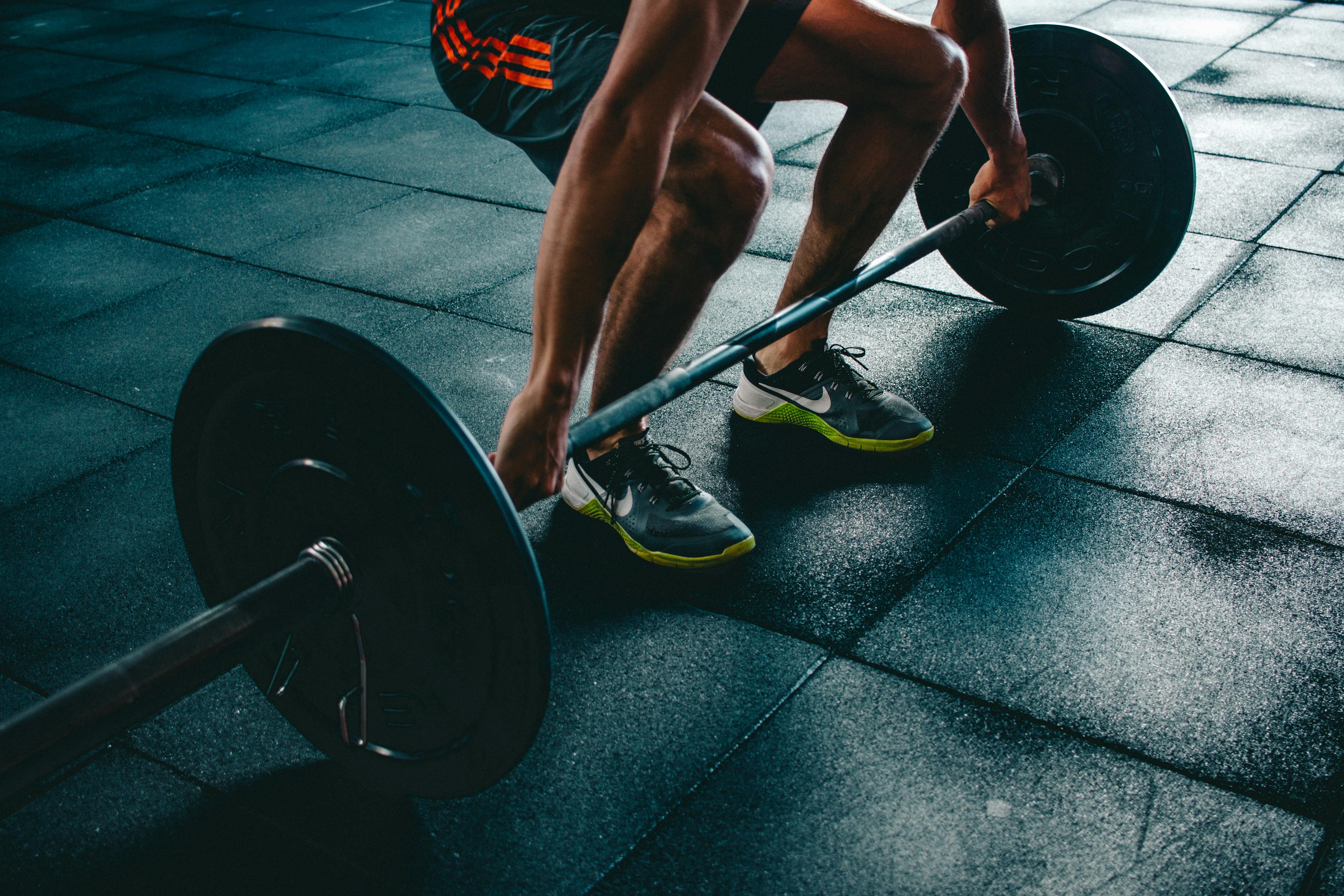
The average deadlift for men who log their lifts on Strength Level is 340 lb (154 kg). That is an average among dedicated lifters, not men in general: no study has deadlift-tested a representative sample. At 200 lb bodyweight, Strength Level puts novice at 297 lb, intermediate at 382 lb, and advanced at 476 lb.
What is the average deadlift for men?
Among men who log lifts on Strength Level, the average one-rep max (1RM)—the most weight you can lift once—is 340 lb. There are no population-wide deadlift data; the closest yardstick is the US Army test, where young male soldiers need a 150-lb trap-bar (hex-bar) triple to pass and 340 lb for full points. That triple is not a straight-bar 1RM.
Strength Level reports 22,978,599 lifts, including 5,398,185 qualifying male results from 2015 to 2026, and says its users may be stronger than the general public; some 1RMs are estimated from rep sets (Strength Level, FAQ). A representative “average guy” number is missing partly because clinic strength studies used machines: Cooper Clinic tested the leg press, with a mean of 137.5 kg (Ruiz et al., 2008).
- The Army’s 17-to-21-year-old male scoring table gives 60 points for a 150-lb trap-bar (hex-bar) triple and 100 points for 340 lb (US Army AFT score tables). It is a useful reference point, but the implement and three-rep format differ from a straight-bar max.
- For your next comparison, use strength standards that match your bodyweight and age. Those give you more context than a single population-free average.
What are the deadlift standards by bodyweight?
At 180 lb bodyweight, Strength Level lists novice at 268 lb, intermediate at 348 lb, and advanced at 438 lb; at 220 lb, those marks are 326, 413, and 512 lb. “Intermediate” means stronger than half of Strength Level users, typically after at least two years of regular training.
Men’s deadlift standards by bodyweight (lb, 1RM)
| Bodyweight | Beginner | Novice | Intermediate | Advanced | Elite |
|---|---|---|---|---|---|
| 140 | 146 | 203 | 274 | 355 | 442 |
| 160 | 174 | 236 | 312 | 398 | 490 |
| 180 | 201 | 268 | 348 | 438 | 535 |
| 200 | 227 | 297 | 382 | 476 | 576 |
| 220 | 252 | 326 | 413 | 512 | 615 |
| 240 | 275 | 352 | 443 | 545 | 652 |
| 260 | 298 | 378 | 472 | 577 | 686 |
| 280 | 320 | 402 | 499 | 607 | 719 |
| 300 | 341 | 426 | 526 | 636 | 751 |
Strength Level describes its categories as benchmarks among its users: beginner at the 5th percentile, novice at the 20th, intermediate at the 50th, advanced at the 80th, and elite at the 95th. Its typical training experience runs from at least one month for beginner to more than five years for advanced and elite; elite lifters are competitive (definitions).
Find your row, then choose the next level as a target. The bodyweight multipliers shrink as bodyweight rises: using LiftDecode’s arithmetic, intermediate is 1.96 times bodyweight at 140 lb and 1.75 times at 300 lb. Competitive data show a similar pattern: the male 99th-percentile deadlift multiplier falls from 4.37 times bodyweight in the 59-kg class to 2.65 at 120 kg and above (Montenegro et al., 2026). If you need to estimate your max from a set, use the 1RM calculator.

How do deadlift standards change with age?
Strength Level’s intermediate standard holds steady from about 25 to 40, then declines gradually: it is 340 lb through age 40, 301 lb at 50, and 254 lb at 60. Compare yourself with your age row before deciding you are behind.
- At 45, the intermediate mark is 322 lb; at 55, it is 278 lb.
- At 60, it is 254 lb; at 65, it is 230 lb (Strength Level).
- Competitive lifters show a wider age range: the 90th-percentile deadlift is 3.25 times bodyweight for men 18–35 and 2.30 times for men over 80 (van den Hoek et al., 2024).
If you are over 40, compare your age and bodyweight before setting your next target; strength training over 40 can help put training in that context.
Is a 225, 300 or 405 deadlift good?
For a 200-lb man, 225 lb is about beginner level among Strength Level users, 300 is about novice, 405 sits between intermediate and advanced, and 500 sits between advanced and elite. At 160 lb, 405 is already advanced and 500 is elite. “Big” and “advanced” are different measures.
- At 160 lb bodyweight: 225 is between beginner and novice; 300 is near intermediate; 405 is advanced; 500 is elite.
- At 200 lb bodyweight: 225 is beginner; 300 is novice; 405 is between intermediate and advanced; 500 is between advanced and elite.
Those comparisons come from Strength Level’s bodyweight standards: at 200 lb, the benchmarks are 227, 297, 382, 476, and 576 lb; at 160 lb, they are 174, 236, 312, 398, and 490 lb (Strength Level). A 300-lb pull is common among lifters who train, but its standing depends on your size. A 225-lb pull is a meaningful early milestone for many average-weight men; it is not an advanced standard. If you track all three lifts, the 1000 lb club gives that deadlift a broader strength context.
What if your deadlift is stuck below standard?
After two years of regular pulling, most lifters should be near intermediate for their bodyweight among Strength Level users. If you are well short, look for a missing progression rule, too little heavy practice, a setup that changes under max loads, or recovery spent elsewhere.
Progress normally slows as you get stronger: the strongest male powerlifters gained total strength at about 0.102 kg per day, compared with 0.211 kg per day for the least strong (Latella et al., 2020). Check these basics before treating slower progress as a true stall:
- Do you have a clear progression rule for adding weight or reps?
- Are you practicing heavy pulls above 60% of your 1RM most weeks? Heavy loads produced greater 1RM gains than light loads in a meta-analysis (Schoenfeld et al., 2017).
- Does your setup change under heavy loads, or is grip limiting the lift? Review deadlift form mistakes that stall your pull.
- Are sleep, stress, or a calorie deficit limiting your recovery?
If one of those checks points to the problem, start with how to increase your deadlift. If the cause is still unclear, see what’s actually holding your deadlift back and use that as a starting point for your next training block.
FAQ
How common is a 300 lb deadlift?
Among men who train, a 300-lb deadlift is fairly common. Among Strength Level users, it is about novice for a 200-lb man and between novice and intermediate for a 160-lb man. There are no data that establish how common it is among men overall.
Is a 225 deadlift impressive?
It is a real first milestone, not an advanced mark. Among Strength Level users, 225 lb is near beginner level for a 200-lb man and between beginner and novice for a 160-lb man. Young male soldiers need a 150-lb trap-bar (hex-bar) triple to pass the Army test, which is not a straight-bar 1RM.
Is 200 lb a good deadlift?
It is a solid starting point. At 180 lb bodyweight, 200 lb is around beginner level among Strength Level users; the novice benchmark is 268 lb. If you train regularly, use novice as a next target rather than treating 200 lb as a limit.
How much can the average guy deadlift?
Among men who log lifts on Strength Level, the average is 340 lb (154 kg). No representative sample of men has been deadlift-tested, so there is no true average for men overall. For comparison, the Army awards young male soldiers full points for a 340-lb trap-bar (hex-bar) triple, not a straight-bar 1RM.
Written and maintained by LiftDecode. Training and nutrition education for healthy adults, not medical advice — if you have a health condition or an injury, talk to a professional who can examine you.