How to Build Bigger Arms (and Why Yours Stopped Growing)
How to build bigger arms when curls stopped working: why arms stall, why triceps need more work, and a weekly arm plan with sets, reps and progression.
- Published
- Reading time
- 6 min
- By
- LiftDecode
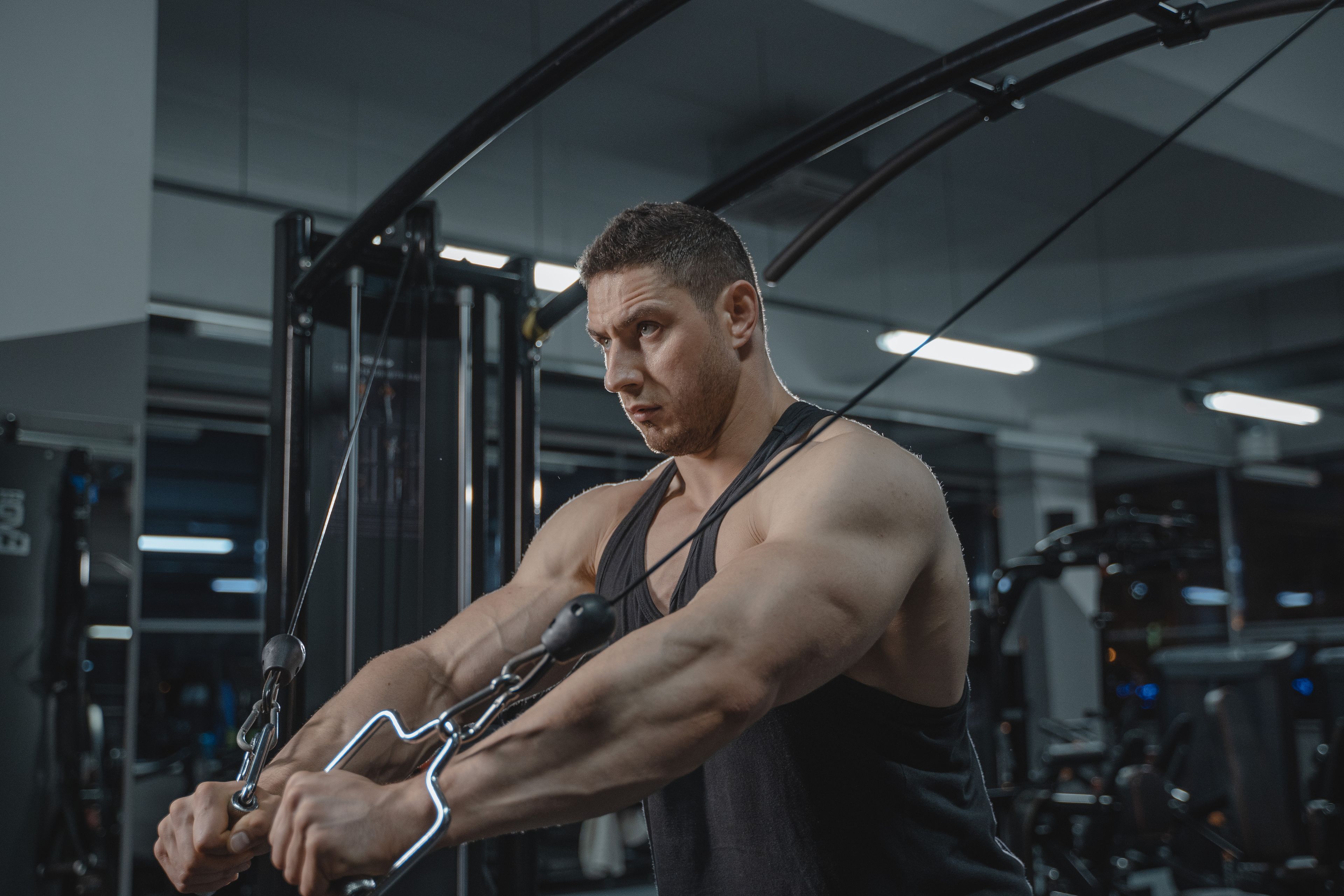
To build bigger arms, give biceps and triceps their own weekly dose: about 6 to 10 hard direct sets each, on top of your pressing and pulling. Include an overhead triceps extension, take sets close to failure through a full range, and add reps before weight. If your bodyweight is flat, fix that first.
Why did my arms stop growing?
For a lifter who already trains arms, check these causes in order: flat bodyweight, too little direct work, undertrained triceps, load jumps that are too big, and sets that stop too far from failure. Start with the first cause that applies, fix it, and hold the other variables steady for 8 weeks.
| Rank | Cause | Self-check | Fix |
|---|---|---|---|
| 1 | Bodyweight flat | Is your 7-day average the same as 8 weeks ago? | Add a small surplus; aim to gain about 0.25–0.5% of bodyweight per week (Iraki et al., 2019). |
| 2 | Token direct arm work | Are you doing fewer than about 6 direct sets per arm muscle per week? | Use two arm slots a week, with 3 sets per exercise. |
| 3 | Triceps undertrained | Do you only do pushdowns, with no overhead extension? | Make one triceps exercise an overhead extension. |
| 4 | Load jumps too big | Have you been stuck with the same dumbbells for 2 months or more? | Add reps first; use cables or microplates. |
| 5 | Sets too easy or too short | Could you do 4 or more reps on your last set, or are you skipping the bottom of curls? | Finish 0–2 reps from failure and use a full range. |
If the whole body has stalled, not just your arms, start with how to gain muscle when it’s stopped coming easy.
Are compound lifts enough to grow your arms?
For beginners, often yes. For lifters whose arms have stalled, direct work usually matters: rows and presses train the arms, but less than curls and extensions, so count each compound set as roughly half an arm set.
- In 29 untrained men, adding curls and extensions to bench presses and pulldowns did not significantly improve muscle-thickness growth over 10 weeks: the groups gained 6.5% and 7.04% (Gentil et al., 2013).
- In a different 8-week study of 10 untrained men, the arm trained with curls gained 11.06% in elbow-flexor thickness, compared with 5.16% in the arm trained with dumbbell rows (Mannarino et al., 2021). Those findings fit together: compound work can be enough for beginners, while direct work can give stalled arms a stronger growth stimulus.
- A review of 67 studies and 2,058 participants found that muscle growth rises with weekly volume, with diminishing returns. Its fractional counting of indirect sets supports the practical rule of counting a compound set as about half a direct arm set (Pelland et al., 2026). See how many sets per muscle group per week for the broader volume picture.
Should you train triceps harder than biceps?
Yes, usually. MRI measurements found the triceps was about 2.6 times the volume of the biceps and roughly 56% of the main upper-arm muscles; overhead extensions also produced more triceps growth than pushdowns in a head-to-head study.
- In 10 adults, measured muscle volume was 372.1 cm³ for the triceps, 143.7 cm³ for the biceps, and 143.7 cm³ for the brachialis (Holzbaur et al., 2007). That puts the triceps at about 56% of those three muscles’ combined volume, rather than the often repeated “two-thirds.”
- In 21 adults training twice weekly for 12 weeks, overhead cable extensions increased whole-triceps volume by 19.9%, versus 13.9% with neutral-position extensions. The long head grew 28.5% versus 19.6%, even though the overhead arm lifted lighter weights (Maeo et al., 2023).
- The brachialis is as large as the biceps in those measurements and works in every curl, especially hammer curls. Keep them in your plan, and see how to grow forearms for related arm work.
Which curls work best for bigger biceps?
Choose the curl you can progress through a full range. Comparisons of curl variations mostly find similar growth; what matters more is keeping the bottom, stretched part of the rep and avoiding momentum.
- In 15 untrained men, preacher curls and behind-the-body Bayesian cable curls produced similar biceps growth over 10 weeks: about 6–7% with preacher curls and 9% at three measurement sites with Bayesian curls, with no significant difference (Attarieh et al., 2025).
- In 19 untrained women, training the initial range of preacher curls produced greater growth in the lower biceps than training only the final range (Pedrosa et al., 2023).
- Pair an incline or cable curl with a preacher or hammer curl. Let the arm straighten at the bottom without swinging, then keep those choices long enough to measure whether they’re working.
What does a weekly arm plan look like?
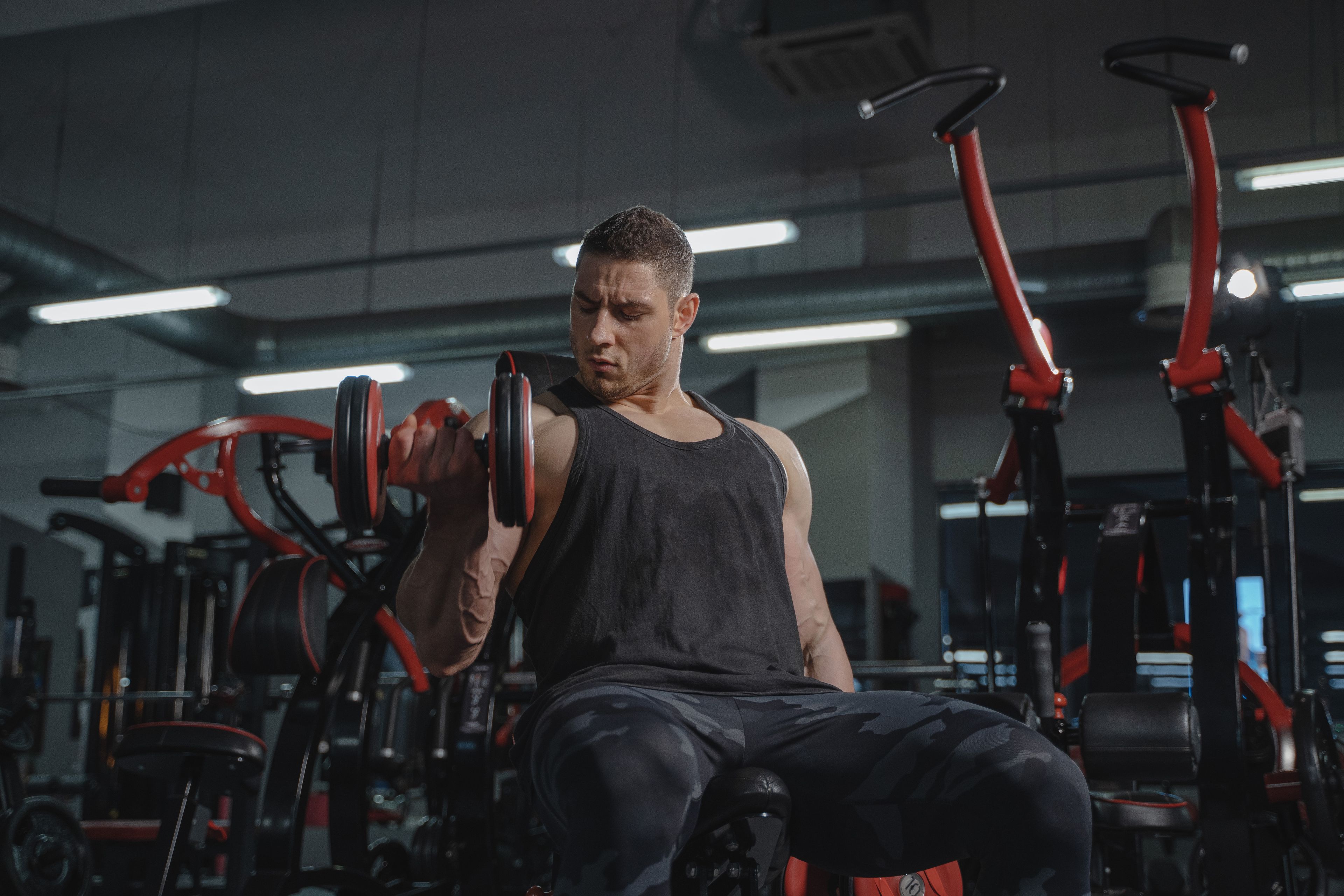
Use two arm slots a week, each pairing one biceps and one triceps exercise for 3 sets of 8–12. That gives you about 6 direct sets per muscle on top of compounds; finish each set 0–2 reps from failure and add reps before weight.
- Slot A, after an upper or pull day: Incline dumbbell curl or cable curl, 3 × 8–12; overhead cable or dumbbell triceps extension, 3 × 8–12.
- Slot B, after an upper or push day: Preacher or hammer curl, 3 × 8–12; pushdown or dips, 3 × 8–12.
- Reach 12 reps on every set before adding the smallest load. That’s double progression: build reps first, then weight.
- At 25 lb (11 kg), jumping to 30 lb (14 kg) is a 20% increase. Use cables, plate-loaded handles, or 2.5 lb (1 kg) microplates; if needed, keep building toward 12–15 reps before switching dumbbells. If you stall after 6–8 weeks while bodyweight rises, add 2 sets per muscle and hold that dose for a month.
What if your arms still won't grow?
Then the problem probably isn’t your arms alone. If bodyweight has been flat for months, your main lifts aren’t moving, or you’re sleeping under 7 hours, your arm work may have little to build with.
- Compare your 7-day average bodyweight and your main-lift top sets with where they were 8 weeks ago. If either is flat, start with why you're not gaining muscle anywhere.
- If several causes fit, fix the highest-ranked one first and hold the rest steady.
If your arms have stalled, something whole-body may have stalled too. The LiftDecode diagnosis asks quick, one-tap questions about your training, eating, and recovery, then ranks your bottlenecks and identifies what isn’t the problem. Find the bottleneck behind your arms before you change anything else.
FAQ
What muscle takes up most of your arm?
The triceps. MRI measurements found it was about 2.6 times the volume of the biceps and roughly 56% of the main upper-arm muscles (Holzbaur et al., 2007). That’s less than the often quoted two-thirds or 70%, but still the largest single target for arm size.
Why am I not progressing on my bicep curls?
The load jump may be too big. Going from 25 to 30 lb dumbbells means 20% more weight, so add reps first, then use the smallest load available. Keep the full range instead of cutting out the bottom half to lift more.
How long does it take to grow biceps?
Expect months, not weeks. Untrained men in a 10-week curl study gained about 6–9% in biceps measurements, while experienced lifters grow more slowly (Attarieh et al., 2025). Measure at the same spot monthly and judge progress over 8–12 weeks.
Can I get bigger arms in 4 weeks?
You may make progress, but four weeks is a short window for lasting size changes. Untrained men gained about 6–9% in biceps measurements after ten weeks of curls (Attarieh et al., 2025). Use the first month to establish two weekly arm slots, overhead extensions, hard sets, and rising bodyweight.
Written and maintained by LiftDecode. Training and nutrition education for healthy adults, not medical advice — if you have a health condition or an injury, talk to a professional who can examine you.