How to Increase Bench Press: A 3-Lever Plan That Works
How to increase bench press after beginner gains: bench more often and heavier, build the pecs and triceps, fix your setup and sticking point. Plan inside.
- Published
- Reading time
- 7 min
- By
- LiftDecode

To increase your bench press, pull three levers: bench two or three times a week with at least one heavy session, build more muscle in your chest, triceps and front delts, and set up so the bar travels a shorter, stronger path. Then add weight in small jumps—2.5 lb (1 kg) at a time—and keep that rule for months.
Why does the bench press stall sooner than other lifts?
Small muscles move the bar—your pecs, triceps and front delts—so a 5 lb jump that feels easy on a squat is a big percentage increase on a bench. After beginner gains, your bench rises only as fast as those muscles grow.
On a 185 lb (84 kg) bench, adding 5 lb is about 2.7% in one session. Adding 5 lb every week would mean a 260 lb increase in a year, so shrink the jumps to 2.5 lb (1 kg). Even Jim Wendler says going from 300 to 400 lb took him about seven years, and calls gaining muscle the best way to raise a bench (Wendler’s advice on the bench press). For more on common causes, read why your bench press stalled, and check where you stand against strength standards.
Lever 1 — How often and how heavy should you bench?
Bench two to three times a week, with at least one heavy session of 1–5-rep sets stopped a rep or two short of failure. Strength responds to frequency and tends to favor heavier loads, so one weekly day of 10-rep sets rarely builds a bigger max.
A meta-regression of 67 studies and 2,058 people found strength rose with weekly frequency and sets, with diminishing returns; frequency had little effect on muscle growth (Pelland et al., 2026). In one eight-week trial, trained men improved their bench one-rep max (1RM)—the most weight they can lift once—by 6.5% with 8–12-rep sets versus 2.0% with 25–35-rep sets. A meta-analysis also found heavier loads favored 1RM gains while muscle growth was similar (Schoenfeld et al., 2015; Schoenfeld et al., 2017).
- Day A, heavy: 4–5 sets of 3–5 reps.
- Day B, moderate and paused: 3–4 sets of 6–10 reps.
- Optional Day C: light technique practice.
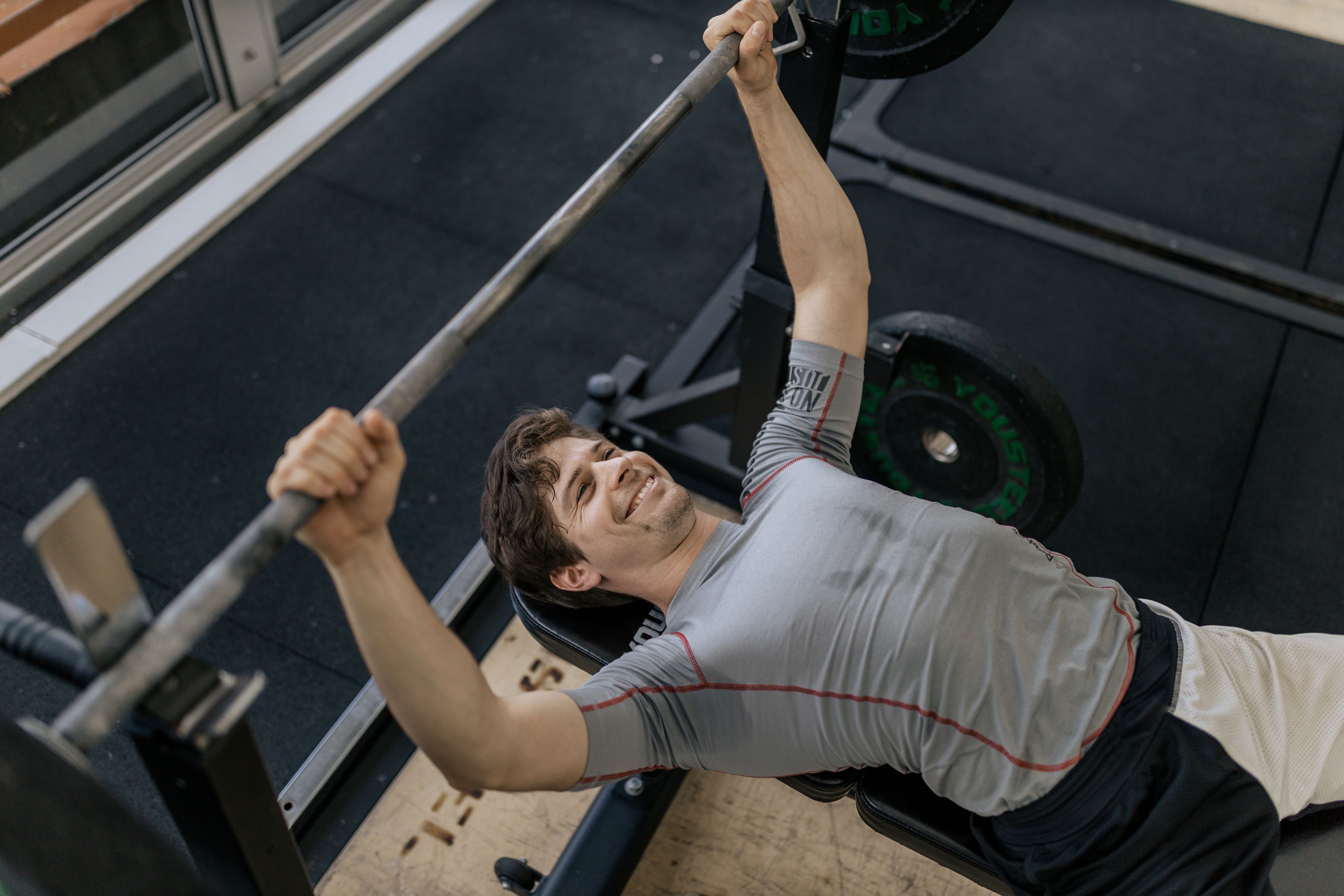
Lever 2 — Why is muscle the ceiling on your bench?
A bigger bench needs bigger pressing muscles. In 83 trained men, pec thickness tracked bench 1RM very closely (r = 0.83–0.88); if your bodyweight and arm size haven’t changed in a year, muscle—not technique or programming—is probably your cap (Nigro et al., 2024).
Add 6–10 hard weekly sets for chest and triceps beyond your bench work. Dumbbell presses, dips, close-grip bench and overhead presses give those muscles more work; rows and pull-ups help build a stable upper-back base. If you’re light for your frame, eat for a slow gain. After your first year, muscle is often the neglected lever.
Lever 3 — How do setup and the sticking point change your bench?
Grip width and back position change how far the bar travels: trained lifters benched more with a medium or wide grip than a shoulder-width grip, and more with an arch. Then train the sticking point—the spot where the bar slows or stalls.
Among 14 men with at least three years of benching, the average 1RM was 109.8 kg (242 lb) with a wide grip, 108.9 kg (240 lb) with a medium grip and 103.7 kg (229 lb) with a narrow grip. Wide and medium grips outperformed narrow; start around 1.4–1.7 times biacromial width, the distance between the bony tips of your shoulders, and adjust for comfort (Larsen et al., 2020). A closer grip may suit your shoulders over the long term. See bench press setup and form mistakes for cues.
A study of 15 highly trained lifters found an arch added 4.2 kg (about 9 lb) to 1RM, with less bar travel than a flat back (Bartolomei et al., 2024). Arching is useful leverage. Keep your upper back tight, feet planted and leg drive consistent.
The sticking region starts about 0.2 seconds after the bar begins rising and lasts about 0.9 seconds. It reflects a mechanically poor position, not lost bounce, so strengthen the position where you stall (van den Tillaar & Ettema, 2010; van den Tillaar et al., 2012).
- Off the chest: paused bench.
- Midway: pin press at the stall height.
- Near lockout: close-grip bench or dips.

What does an 8-week bench plan look like? (worked example)
For a lifter stuck at 185 lb (84 kg) for five reps, try two bench days a week—one heavy, one paused—plus chest and triceps work. The loads below are illustrative; add 2.5 lb (1 kg) when you complete every heavy rep.
- Day A, heavy: 5×3 at 195 lb (88 kg), ending each set with about one rep left.
- Day B, paused: 4×6 at 155 lb (70 kg), pausing one second on the chest.
- Accessories: dumbbell press 3×8–12, dips or close-grip bench 3×8–12, overhead press 3×6–8, rows 4×8–12.
- Progress: Complete all 5×3 cleanly, then add 2.5 lb (1 kg). For Day B, use double progression: build from 4×6 to 4×8, then add 5 lb (2.5 kg).
- If you miss: Repeat the weight; after two misses, drop 10% and rebuild. In week 8, test or estimate your max with a rep set and the bench press calculator.
Eight clean weeks of 2.5 lb jumps add 20 lb (9 kg) to the heavy sets. Most intermediates will repeat weeks, and that is part of the plan.
Which lever should you pull first?
Match the lever to the symptom: rarely benching heavy means practice; bodyweight and arms unchanged for a year points to muscle; stalling at the same spot points to leverage. If all three are covered and your bench still won’t move, look beyond the lift.
| Symptom | Lever | First fix |
|---|---|---|
| You bench once a week, or rarely lift heavier than 8 reps | Practice | Bench 2–3×/week; one day of 1–5-rep sets |
| Bodyweight, chest and arm size unchanged for a year | Muscle | 6–10 extra weekly sets for chest/triceps; eat for a slow gain if light |
| Bar stalls at the same height every heavy set | Leverage (sticking point) | Paused bench; pin press just below the stall |
| Grip at shoulder width, flat back, feet loose | Leverage (setup) | Grip ~1.4–1.7× shoulder width; tight upper back and arch; leg drive |
| Stalls at lockout | Muscle (triceps) | Close-grip bench, dips |
| All five covered, still stuck | Not the bench | Check sleep, calories, recovery, pain |
Sleep, eating in a deficit, too much other pressing and shoulder pain can limit progress; if pain sets your ceiling under load, see a physio. If you’ve worked all three levers for two months and the bar still won’t move, find which lever—or outside cause—is holding your bench.
FAQ
How long does it take to add 20 lbs to your bench press?
At 2.5 lb (1 kg) per successful week, 20 lb takes eight straight weeks—a realistic pace for newer lifters and an optimistic one for most intermediates. Past the first year or two, expect months; Wendler says his bench took about seven years to rise from 300 to 400 lb (Jim Wendler).
How often should I bench to increase my bench press?
Two to three times a week suits most lifters. A 2026 meta-regression of 67 studies found strength gains rose with weekly frequency, with diminishing returns (Pelland et al.). Make one session heavy, with 1–5 reps, and one moderate and paused.
Does grip width change how much you can bench?
Yes. Lifters with at least three years of benching lifted about 5–6 kg (11–13 lb) more with a medium or wide grip than with a shoulder-width grip (Larsen et al., 2020). If a wide grip hurts your shoulders, bring your hands slightly closer.
How long does it take to go from a 135 to a 225 bench?
It depends more on training age and muscle than on a particular program: early gains come faster, then smaller jumps follow as your pecs, triceps and delts grow. Bench two or three times weekly, use small increments and build muscle; see how common 225 is in our bench 225 guide.
Written and maintained by LiftDecode. Training and nutrition education for healthy adults, not medical advice — if you have a health condition or an injury, talk to a professional who can examine you.