Average Bench Press for Men by Age and Bodyweight
The average bench press for men is 131 lb untrained, 159 lb in clinic tests and 212 lb among lifters who log. Tables by age and bodyweight, with sources.
- Published
- Reading time
- 7 min
- By
- LiftDecode

The average bench press for men depends on who you count: active young men with no strength training averaged 131 lb (59 kg) in one lab study, Cooper Clinic men averaged 159 lb (72 kg) on a machine, and men who log lifts on Strength Level average 212 lb.
What is the average bench press for men?
Numbers range from about 130 lb to 280 lb across different groups. Untrained young men averaged near 130 lb; clinic-tested adult men, 159 lb; app users who log lifts, 212 lb; and drug-tested powerlifters, 281 lb at the median.
These are different populations and tests, not competing estimates of what the average man can lift. A one-rep max (1RM) is the most weight you can lift for one repetition.
| Group | Who they are | Average or median bench | Test |
|---|---|---|---|
| Untrained young men | 259 active students; no strength-training history; 145 lb average bodyweight | 131 lb (59.3 kg) mean | Smith machine 1RM |
| Clinic-tested adult men | 8,762 Cooper Clinic men; average age 42 | 159 lb (72.0 kg) mean; 0.9× bodyweight | Universal machine 1RM |
| Men who log lifts | Strength Level users, 2014–2026 | 212 lb mean | Self-reported; some 1RMs estimated |
| Competitive powerlifters | Drug-tested, unequipped 2024 meet entries | 281 lb (127.5 kg) median | Paused competition single |
Sources: untrained men (Fernandez Ortega et al., 2022), Cooper Clinic (Ruiz et al., 2008), Strength Level and powerlifting meet entries (van den Hoek et al.). For strength standards for every major lift, start with the population that fits you.
Why do "average bench" numbers disagree so much?
Each dataset covers a different group and uses a different test. App users skew toward dedicated lifters and may have estimated 1RMs; clinics used machines; lab studies often have small, young samples. None is a random sample of all men.
- Who shows up: Strength Level notes that users “might be, on average, stronger than the general population” (Strength Level FAQ). Cooper Clinic men were mostly white, well educated, and middle to upper socioeconomic status (Ruiz et al., BMJ 2008).
- What gets tested: Cooper used Universal variable-resistance machines; Strength Level estimates some 1RMs from rep sets (Strength Level FAQ).
- How many men train: In 2020, 35.2% of U.S. men met the federal muscle-strengthening guideline, which also includes activities like push-ups and sit-ups (CDC MMWR).
- What national data exist: The first nationally representative U.S. strength estimates measured handgrip, not bench press (Perna et al., 2016).
Compare yourself with men who train, and check which group a number describes.
What is the average bench press by bodyweight?
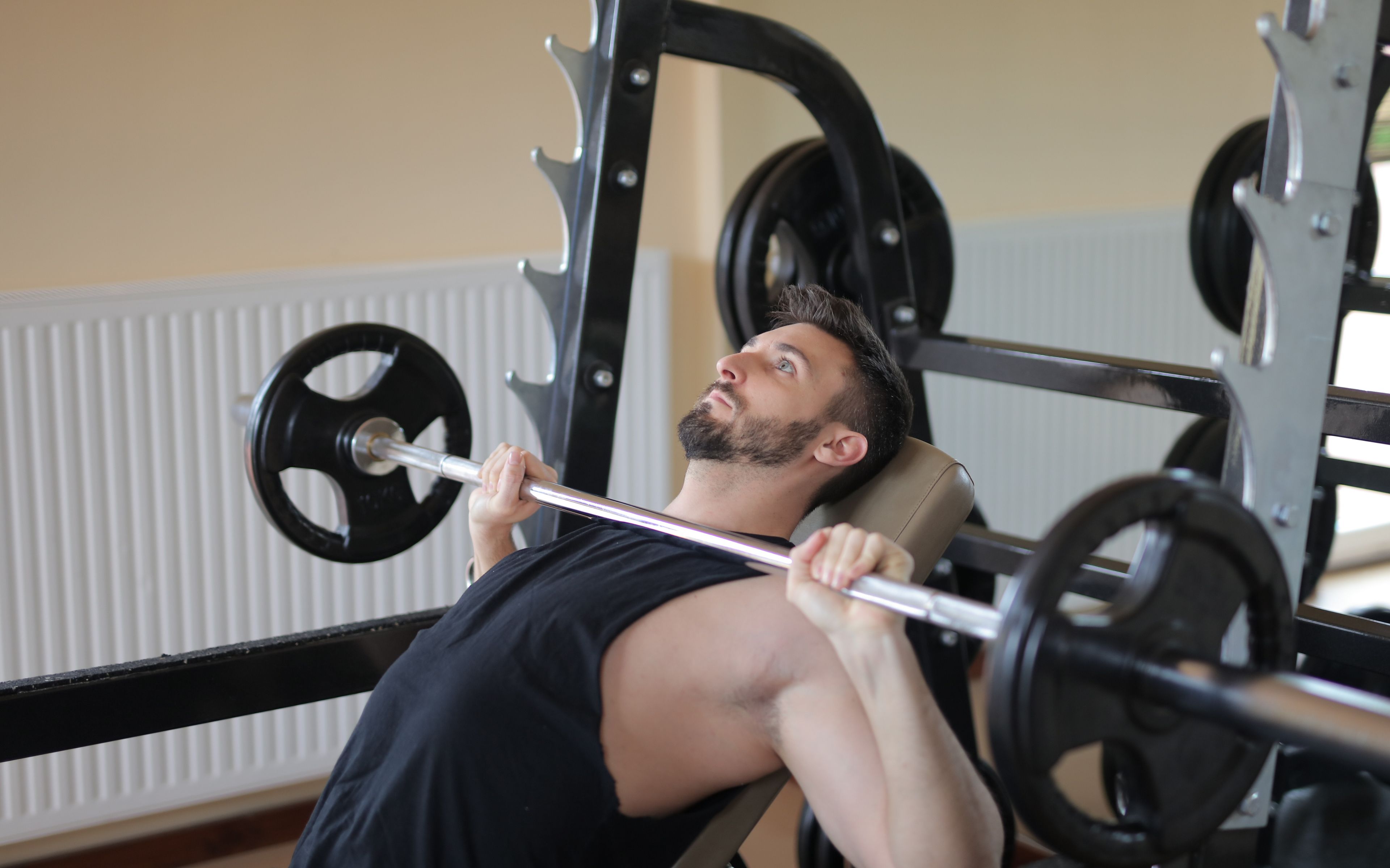
Among men who log lifts, Strength Level’s intermediate level—stronger than 50% of users—ranges from 156 lb at 130 lb bodyweight to 243 lb at 200 lb and 342 lb at 300 lb. Heavier men bench more pounds but less per pound of bodyweight.
The intermediate figure is about 1.2 times bodyweight at 130 lb and 1.14 times at 300 lb. Strength Level’s figures describe users who log lifts and are current as of September 2026.
| Bodyweight | Novice (stronger than 20%) | Intermediate (stronger than 50%) | Advanced (stronger than 80%) |
|---|---|---|---|
| 130 lb | 114 lb | 156 lb | 205 lb |
| 150 lb | 137 lb | 183 lb | 236 lb |
| 170 lb | 158 lb | 208 lb | 264 lb |
| 180 lb | 169 lb | 220 lb | 277 lb |
| 200 lb | 189 lb | 243 lb | 303 lb |
| 220 lb | 208 lb | 265 lb | 327 lb |
| 250 lb | 236 lb | 295 lb | 361 lb |
| 280 lb | 261 lb | 324 lb | 393 lb |
| 300 lb | 278 lb | 342 lb | 413 lb |
Relative strength also falls non-linearly as body mass rises among drug-tested classic powerlifters (Montenegro et al., 2026). The CDC reports an average U.S. male weight of 199.0 lb (CDC FastStats). Use bench press standards by level to see what to aim for, or the bench press calculator to estimate your max from reps.
What is the average bench press by age?
Among app users, the middle-of-the-pack bench is 212 lb from ages 25 to 40, 188 lb at 50, and 158 lb at 60. In clinic testing, the middle band for a 199 lb man falls from about 197–227 lb in his 20s to 141–157 lb in his 50s.
Clinic values below convert Cooper Institute bodyweight ratios using 199 lb, the CDC average male weight. Clinic machine results and app-user barbell numbers are different yardsticks.
| Age | Strength Level intermediate (middle of app users, lb) | Cooper Clinic middle band (40th–60th percentile) at 199 lb bodyweight |
|---|---|---|
| 20–29 | 207–212 | 197–227 lb (0.99–1.14×) |
| 30–39 | 212 | 175–195 lb (0.88–0.98×) |
| 40–49 | 201–212 | 159–175 lb (0.80–0.88×) |
| 50–59 | 173–188 | 141–157 lb (0.71–0.79×) |
| 60+ | 158 (age 60) | 131–143 lb (0.66–0.72×) |
Drug-tested powerlifters show a similar age pattern: relative strength peaks at 18–35 and declines later. Even men over 80 at the 90th percentile bench 1.31 times bodyweight (van den Hoek et al., 2024).
Is 135, 200, 225 or 250 a good bench for a man?
For a man around the U.S. average weight of 199 lb, 135 is just below Strength Level’s beginner mark, 200 falls between novice and intermediate, 225 is just below the app-user middle, and 250 is just above it. At that bodyweight, 225 is top-20% among clinic-tested men in their 40s.
At 200 lb bodyweight, Strength Level’s benchmarks are 144 lb beginner, 189 lb novice, 243 lb intermediate, and 303 lb advanced (Strength Level).
- 135 lb: Just below beginner.
- 185 lb: Near novice.
- 200 lb: Above novice, below intermediate.
- 225 lb: Just below intermediate.
- 250 lb: Above intermediate, below advanced.
Cooper Clinic men aged 40–49 reached 1.00 times bodyweight at the 80th percentile and 1.20 times at the 95th (Cooper norms via ACE). At 199 lb, that is about 199 and 239 lb. See what percentage of men can bench 225.
How long does it take to reach an average bench?
Strength Level defines intermediate—the middle of the pack—as at least two years of regular training; novice is at least six months. Progress is fastest early and slows as you get stronger, so the second 50 lb takes longer than the first.
- Beginner: Stronger than 5%; practiced at least one month.
- Novice: Stronger than 20%; practiced at least six months.
- Intermediate: Stronger than 50%; practiced at least two years.
- Advanced: Stronger than 80%; practiced more than five years.
- Elite: Stronger than 95%; practiced more than five years and competes.
These are definitions, not guarantees or a schedule (Strength Level). A 15-year analysis of 1,271 male powerlifters found the strongest group gained about half as much total strength per day as the least strong group (Latella et al., 2020). If two years of regular training still leaves you below novice for your bodyweight, look for a specific limit.
What should you do if your bench is stuck below average?
First confirm it is stuck: the same weight and reps for 6–8 weeks despite consistent training. Then look for a cause, such as no progression rule, too little heavy practice, stopping sets far from failure, or poor recovery.
- Is there a written progression rule?
- Do you bench heavy—above about 60% of your 1RM—most weeks?
- How often do you bench?
- Do sets end with several reps left?
- Are sleep or life stress interfering?
- Are you in a calorie deficit?
Heavy loads produce bigger 1RM gains than light loads, even when both go to failure; hypertrophy was similar in a meta-analysis of 21 studies (Schoenfeld et al., 2017). For help sorting out a stall, start with why a bench press stalls, then find out which bottleneck is holding your bench back.
FAQ
Is benching 225 good for a man?
Yes, for most men, though it is not rare among men who train. At about 200 lb bodyweight, it is just below Strength Level’s intermediate mark of 243 lb; by clinic norms, 225 at 199 lb ranges from middle of the pack in the 20s to top-5% in the 50s.
How rare is a 250 bench?
Among men who train, 250 lb is a solid intermediate lift, not a rarity. For a 200 lb man, it is just above Strength Level’s intermediate mark of 243 lb and below advanced at 303 lb.
Is 200 lbs a good bench?
At average male bodyweight, 200 lb is between novice and intermediate: above Strength Level’s novice mark of 189 lb and below intermediate at 243 lb. In Cooper Clinic norms, it is about a bodyweight bench, near the 40th percentile in the 20s and around the 80th percentile in the 40s.
Is a 70 pound bench press good?
For an adult man, 70 lb is a starting point, not a standard. At 120 lb bodyweight it equals Strength Level’s beginner level; if you are there after your first month, focus on technique and small weekly increases.
Written and maintained by LiftDecode. Training and nutrition education for healthy adults, not medical advice — if you have a health condition or an injury, talk to a professional who can examine you.