Why Are My Biceps Not Growing? 6 Reasons and the Fix
Biceps usually stall for one of six reasons: fewer than about 10 hard sets a week (rows and pulldowns count only half), sets stopped far from failure, curls that skip the stretched bottom position, no progression on the same exercises, too little food or sleep for any muscle to grow, or the normal slow pace of arm growth. Count your weekly sets first; that alone fixes most cases.
Asking because your progress stalled? The program is rarely the whole story. The diagnosis reads how you train, eat, sleep and recover, and ranks what is actually holding you back.

- Published
- Reading time
- 6 min
- By
- LiftDecode
Most biceps that will not grow are getting too little direct work. Rows and pulldowns help, but only at about half credit, so many lifters who "train arms" give their biceps six to eight real sets a week. After volume come effort, the stretched position, progression, and the basics that grow every muscle. Here are the six reasons, in the order to check them.
Why are my biceps not growing?
Usually one of these, roughly from most to least common:
- Too few weekly sets: under about 10 hard sets, counting rows as half.
- Sets too easy: stopped four or more reps short of failure.
- No stretch: curls done with the elbow in front of the body only, or with a short range.
- No progression: different exercises and weights every week, nothing to beat.
- Food and sleep: not enough of either for any muscle to grow.
- Normal pace: arms are small muscles that grow slowly, and some people grow much slower than others.
How many sets do biceps need to grow?
About 10 or more hard sets a week, like any muscle. In a meta-analysis of 15 studies, each extra weekly set added about 0.37% more growth, with the best results at 10 or more (Schoenfeld et al., 2017). Most lifters overestimate their biceps volume because they count every pull fully.
The training volume calculator adds up your week with rows and pulldowns counted as half. If biceps reads under 10, that is your first fix: add four to six direct sets spread over two days.
Do rows and pulldowns grow your biceps?
Yes, but less than direct curls once you are past the beginner stage. In untrained men, bench press plus pulldowns grew the elbow flexors 6.5% in 10 weeks, and adding curls made no extra difference (Gentil et al., 2013). For trained lifters, counting compound sets as half a set for the arms fitted the growth data best across 67 studies (Pelland et al., 2026).
So beginners can grow arms on compounds alone. After the first year, direct work becomes the difference.
Are your curls hard enough?
Often not. Muscle growth increased as sets ended closer to failure in a meta-regression of resistance-training studies (Robinson et al., 2024). Curls are where lifters stop early, because the burn arrives before the muscle is near its limit. End most sets with one to three reps in reserve; going fully to failure on every set adds little (Refalo et al., 2023).
A quick test: if you could do five more reps with good form, the set did not count.

Which curls grow biceps best?
The ones that load the biceps hard at the stretched bottom position, done through a full range. Full range of motion beat partial range for growth across 16 studies (Pallarés et al., 2021), and in trained lifters, partial reps kept in the stretched half grew the elbow flexors as much as full reps (Wolf et al., 2025). Half-reps at the top are the ones that cost growth.
Good choices: incline dumbbell curls, preacher curls, and cable curls facing away from the stack. Focusing on squeezing the biceps also helped: elbow-flexor thickness rose 12.4% with an internal focus versus 6.9% without in untrained men (Schoenfeld et al., 2018).
Why are your biceps not growing even with enough sets?
Usually because nothing progresses. Changing exercises every week means there is never a number to beat. Pick two curls, keep them for eight to twelve weeks, and use double progression: add reps until the top of your range, then add weight. In 43 trained lifters, adding reps at a fixed weight built about as much muscle as adding load (Plotkin et al., 2022).
Are you resting long enough between arm sets?
Probably, unless you rush supersets. A Bayesian meta-analysis of 9 studies found a small growth benefit to resting longer than 60 seconds, likely because reps hold up better, and no clear difference beyond 90 seconds (Singer et al., 2024). If your second and third sets of curls lose half their reps, rest a little longer.
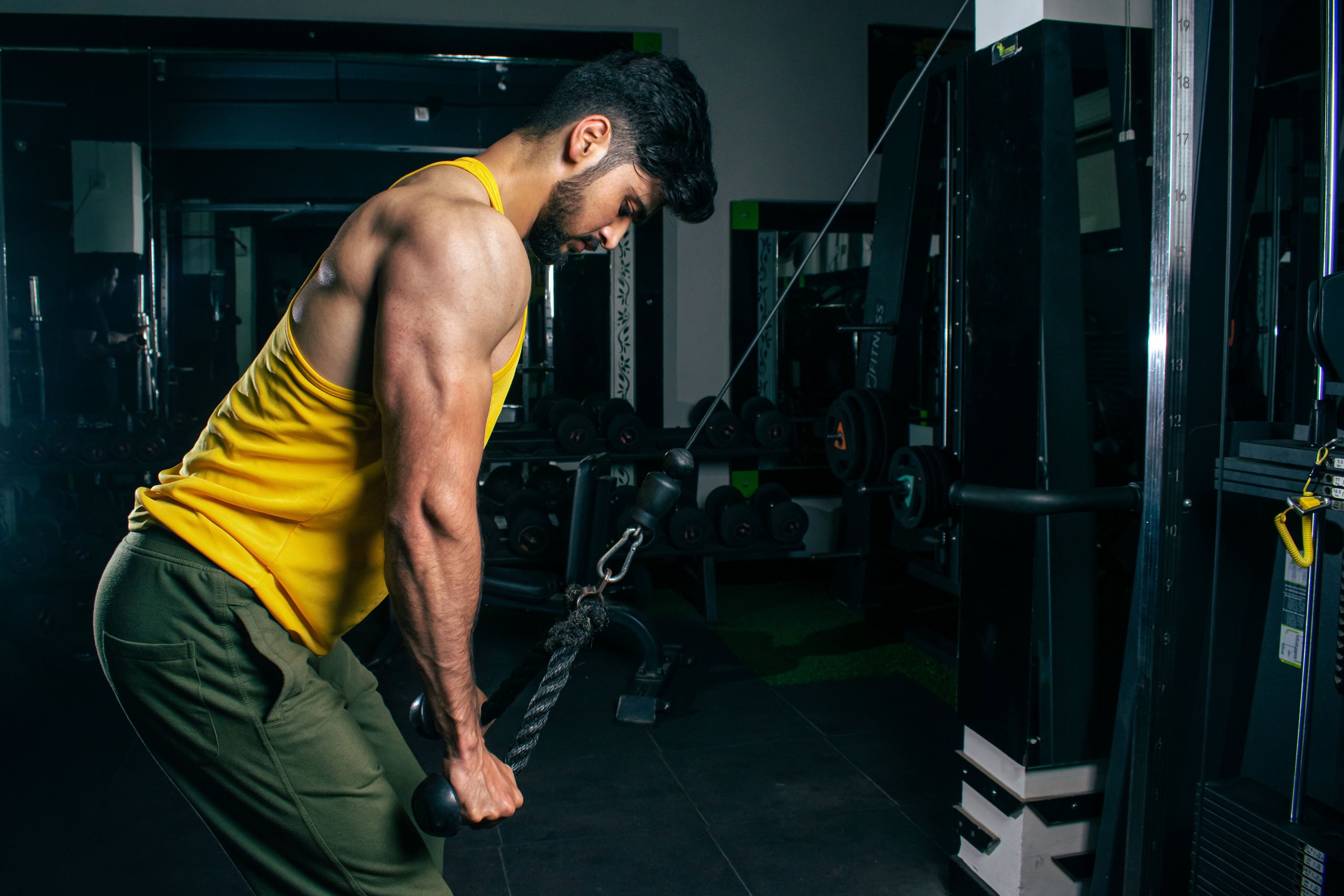
Why are my triceps not growing?
Often for the same reasons, plus one: no overhead work. The long head of the triceps is stretched most with the arm overhead. In 21 adults training one arm each way for 12 weeks, overhead cable extensions grew the long head 28.5% versus 19.6% with pushdowns, and the whole triceps about 1.4 times as much (Maeo et al., 2023).
Keep pressing for strength, and make one triceps exercise an overhead extension.
Why are my arms not growing at all?
If your arms, chest and legs have all stalled, the problem is not arm training. It is food, sleep or recovery. Lean-mass gains were impaired when lifters trained in a calorie deficit (Murphy & Koehler, 2022), and protein gains levelled off around 1.6 g per kg a day (Morton et al., 2018). When nothing grows, read why you are not gaining muscle.
How fast should your biceps grow?
Slowly, and at very different rates between people. On the same 12-week arm program, biceps size changed anywhere from −2% to +59% across 585 people (Hubal et al., 2005). Arms are small muscles: even good growth adds only fractions of an inch a year once beginner gains are gone. Judge over three months with a tape measure, not over two weeks in the mirror.
How do you grow biceps that are stuck?
Fix the six reasons in order, and give each change eight to twelve weeks:
- Reach 10–14 weekly sets, counting rows and pulldowns as half.
- End most sets one to three reps short of failure.
- Use curls that load the stretch, through a full range.
- Keep the same two curls and add reps, then weight.
- Split the sets over two days. Training a muscle twice a week grew it more than once a week across 10 studies (Schoenfeld et al., 2016).
- Eat at maintenance or above, with enough protein, and sleep seven hours or more.
What does a biceps week that works look like?
Two arm days, with direct work in the stretch and the compounds you already do:
| Day | Exercise | Sets | Biceps credit |
|---|---|---|---|
| Day 1 | Rows | 3 | 1.5 |
| Day 1 | Incline dumbbell curl | 4 | 4 |
| Day 2 | Pulldowns | 3 | 1.5 |
| Day 2 | Preacher or cable curl | 4 | 4 |
| Week | 11 |
Repeat the same pulls on both days if you prefer; the credit is the same. If your biceps still have not moved in three months on a week like this, something outside the gym is limiting you: find out what.
FAQ
How long does it take to see biceps growth?
Measurable growth shows within a few months of consistent hard training; the mirror usually takes longer.
Should I train biceps every day?
No. Two or three sessions a week with enough hard sets beats daily light work.
Do chin-ups build biceps?
Yes, more than wide pulldowns, but they still count as about half a set. Add curls to reach 10 or more.
Are small biceps genetic?
Partly. Response varies widely between people, but almost everyone grows with enough volume, effort and food.
Written and maintained by LiftDecode. Training and nutrition education for healthy adults, not medical advice — if you have a health condition or an injury, talk to a professional who can examine you.